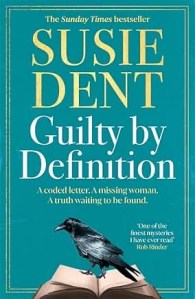
Guilty by Definition by Susie Dent

This was another of my spontaneous buys. I’m most tempted by books to buy when I’ve a gap in my publishing work or I’m working on a non-fiction book, as I’ve done over the past week. Sometimes I find it difficult to read a novel of choice – one I’ve bought – alongside one I’m editing. When editing, you need to immerse yourself deeply in the story and while I make lots of notes, there are always inconsistencies or questions that pop up as I go along, and much has to be held in one’s head.

I saw Guilty by Definition in my local Waterstones. I recognised the name of the author – even though I don’t watch Countdown on TV – and knew she was a ‘word’ expert. Well, how can a book editor resist a debut novel by a word expert! Especially a book that centres on words: their meaning now and their origins and original meaning.

But this is also, and primarily, a crime story, which is set within the offices of a dictionary – Clarendon English Dictionary (CED) – based in Oxford. The senior editor Martha Thornhill has just returned from living in Berlin. Quite why she’s come back now is one of the mysteries but a far bigger one is the disappearance of her older sister, Charlie (Charlotte), ten years ago.

Martha is living with her father, Gabriel; her mother has recently died. There are all kinds of unspoken tensions between them connected to Charlie’s disappearance. Charlie was the beautiful, exceptionally bright daughter; Martha lived in her shadow. Her mother never gave up believing that Charlie was still alive somewhere and would one day come back.

Into this uneasy situation comes ‘Chorus’. Letters, signed ‘Chorus’, start arriving at the CED offices. The letters are hard to decipher. A knowledge of linguistics, Shakespeare and an aptitude for solving crosswords helps. Then it turns out that there are postcards too, some from years ago, which are being sent to anyone connected to the CED (Charlie briefly worked there), even Safi who is relatively new and was still at school when Charlie disappeared. Dates and information in the letters make it obvious that they are about Charlie and perhaps hold the answer to what happened to her.

Reluctantly, Martha realises she must find out more about her missing sister. She also has the guilty feelings and grief that have haunted her for ten years to contend with, but it soon becomes obvious that more people are connected to Charlie and her disappearance than she’d ever realised. Helped by her colleagues Safi, Alex and Simon, they decipher the message hidden in each of the letters and are soon investigating various leads which they hope will solve mystery.

Martha has always thought the best of Charlie – that she was bright, well-loved and respected. But she quickly has to face the truth of there being a darker side to her sister. Why did A-student Charlie suddenly stop working properly on her PhD? What was the book she said she was writing and where is it? When she was working for a second-hand bookseller, was she really syphoning off the best finds at auctions and selling them herself and not declaring them to her boss?

There are many twists and red herrings and I really didn’t know (as in the best crime books) how it would all resolve until the end. We are caught in a wonderful unravelling of secrets and mysteries as the story unfolds. What happened to Charlie? Was she murdered? Or is she still alive somewhere? And who, crucially, is Chorus? And why are they sending the letters? What do they know?

Each chapter is headed with an old word, e.g.: mathom, noun, (Old English), which means ‘a precious thing; a valuable gift’. Within the text, words and their origins and meanings are also discussed. I liked ‘a tidsoptimist‘ – ‘It’s Swedish. A time optimist.’

At the heart of the story though, is the growing possibility that Charlie discovered a ‘commonplace book’ when she was at an auction, dating as far back as Shakespeare. If she did, and if it was written by who it becomes increasingly likely to have been, it would be a huge find. As big as Tutankhamun we are told. A find you could be murdered for …

I loved all the mystery; I loved the words; I loved the excitement of a huge literary find and what it feels like to be involved in it. But Susie Dent has also created some strong characters who each have their own stories as well as their connection to Charlie, so you really engage with them. I don’t want to give too much away. It’s a great read. The cover quotes Rob Rinder as saying, ‘One of the finest mysteries I have ever read.’ And it’s certainly one of the best I’ve read too … different to the standard crime book and all the more exciting for its originality.

Claire Keegan: Small Things Like These

There was a touch of serendipity to my coming to read this book. I finished a publishing job at lunchtime, the sun came out, I decided to head down to the high street and take a walk along the Thames. Then I thought, well, it would be nice to grab an afternoon coffee somewhere but I need something to read … so I headed into Waterstone’s and it was Claire Keegan’s book that took my eye from the pile on the table. It looked familiar; maybe I’d read it before? But no, I hadn’t. It was published in 2021 and shortlisted for the Booker Prize in 2022. It’s short – a mere 116 pages – but as we all know, small can be beautiful and this book was so stunningly good that when I finished it last night just before bedtime, I was left in awe of its power and took my thoughts about it to bed with me.

Set in Ireland in 1985 in the run-up to Christmas, the weather is bitter. Keegan’s opening beautifully  evokes the season: ‘In October there were yellow trees. Then … the long November winds came … and stripped the trees bare … the River Barrow, dark as stout, swelled up with rain. The people … unhappily endured the weather.’ 

We meet Bill Furlong, a coal merchant, and it’s his busiest time of year. Bill, we are told, ‘came from nothing’. His mother fell pregnant at the age of 16 and when her family disown her, her employer, a widow Mrs Wilson, keeps her on as a domestic in her large house on the edge of town and gives her and her baby, born in April 1946, a home. Mrs Wilson takes the growing Bill under her wing, teaching him to read and continuing to give him a home when his mother dies while he’s still young. Later, when Bill marries Eileen, Mrs Wilson gives them a generous amount of money to get them started in their life together, and they go on to have five daughters.

The generous, kind and unprejudiced behaviour of Mrs Wilson to Bill and his mother lies at the heart of this story and shapes Bill’s choices. It’s based on the real history of the Magdalene laundries, run by Roman Catholic institutions, where pregnant women, or women seen as promiscuous, were incarcerated for life, made to work for no money and were appallingly treated. They operated from 1922 until – quite shockingly – 1996.

At the beginning of the book, Bill is ‘disinclined to dwell on the past’. He’s attracted to Eileen’s ‘practical, agile mind’ but we soon see that she’s less forgiving of poverty than Bill and scolds him when he gives money or free coal to those in need. When they disagree on things like this, he lies awake at night ‘going over small things like these‘. These ‘small things’ are a seed though and an incident will cause Bill mental turmoil as he struggles with a moral choice and is forced to look at his past. 

When making a delivery to the local convent, which has a laundry, he finds himself in a small chapel and sees girls scrubbing the floor on their hands and knees. One of them begs him to help her escape; she would rather drown herself in the nearby river than stay there. But then he’s distracted by one of the nuns coming and is taken away. However, he can’t forget the experience and it plays on his mind. The next time he finds a girl in the coal shed, obviously left there as a punishment, and takes her to the house. The Mother Superior glosses over it, suggests it was all a mistake and makes a show of being kind to the girl. Bill doesn’t believe it though. He’s now confronted with his own past, the knowledge that if it hadn’t been for Mrs Wilson, then his own mother would have been treated like this girl and what would have happened to him.

The locals hear about the incident and it’s obvious that they won’t accept him challenging the nuns. It’s clear everyone knows what goes on at the laundry but the nuns are generous and no one wants to upset them. Eileen doesn’t want him to do anything. She cruelly reminds him of his background which is seen as shameful and tells him that he risks their girls not getting into the covent’s highly acclaimed school if he upsets the nuns.

Bill is painfully torn between his own life’s history, his distress at what he’s witnessed and his wife’s and the locals’ desires not to upset the nuns. ‘He felt the strain of being alive … It seemed both proper and at the same time deeply unfair that so much of life was left to chance.’

He’s drawn back to the convent on Christmas Eve, finds another girl in distress in the coal shed … what is he to do? Can he turn his back on what he’s uncovered or must he do something regardless of the consequences? ‘… he found himself asking, was there any point in being alive without helping one another?’

Bill’s story is simply but elegantly told and its power lies not only in the truth of the story of the laundries, but Keegan’s sharp understanding of how life’s experiences shape us and can cause moral turmoil as we question what’s right and where our loyalties lie.

‘The result,’ says the Telegraph, ‘is a truly exquisite, tenderly hopeful Christmas tale in which compassion and altruism triumph over apathy and inertia.’ 

**************

Please note that the website address for this blog is now: www.kaygaleeditorialservices.wordpress.com

Snow by John Banville

7EA3341C-330A-4962-B9DD-473865526B11_4_5005_c

I rarely buy crime or thriller books to read ‘for pleasure’, as opposed to reading ‘for work’. I used to read, many years ago, crime books by P.D.James, Robert Goddard, and others. I’m not sure quite why I abandoned the genre but perhaps it was because many of my ‘work’ books – books I’m sent to edit or proofread – are this genre. I actually quite like working on them, have even enthusiastically requested that the author’s next book comes to me, but my ‘pleasure’ books, the ones I buy to read when work is slow and I have time, or am on holiday, have taken a different direction.

So what attracted me to read this crime story by John Banville? Partly, I think, because my last piece of editing work was a dystopian, post-pandemic novel which, rather than taking me into a world of escapism, took me instead into a worst-case scenario future. Perhaps there was something to be said for those crime stories after all – you know where you stand with a bit of old-fashioned blood and gore, a wily detective and a host of suspects. I also caught sight of a good review and was intrigued to read a John Banville book of this kind – so it was ordered.

I read John Banville’s Booker Prize winning novel The Sea when it was published to much acclaim back in 2005. Although I remember little of it (I’m not good at long-term memory when it comes to the details of books read years ago and am always in awe of those who are), I do clearly remember I thought it was brilliant. I know that Banville turned to writing crime under the pseudonym Benjamin Black, so it was interesting that he’d abandoned the well-used pseudonym for his real name with this book, despite it having the same setting and characters (though a change in central character). What was this fusion of genre writing with literary writing?

The fusion is a combination of an old-fashioned country house mystery – à la Agatha Christie – and a beautifully written story. 

Set in 1957 in Ireland, Detective Inspector St John Strafford is called from Dublin to investigate a murder at Ballyglass House in County Wexford. A body has been found in the library (think Cluedo!), and a cast of eccentric characters appear, all with some possible motive for killing the man. But the man isn’t just any man, he is a priest, and thus the power of the Catholic Church will play an important role in determining the outcome of Strafford’s investigation. 

So, a country house, a body and a host of suspects. But Strafford in no Hercule Poirot. Strafford is a man with his own demons; insecure; uncertain he’s cut out for police work; a loner who stands apart from the world. Even his inability to tolerate alcohol means he’s unable to socialise and be accepted as some kind of ‘ordinary’ man – it’s merely an embarrassing burden for him to bear. And there is the mystery of his aristocratic background and why he chose this police route rather than become a barrister as his father hoped. As we witness his agonised internal brooding, his surprising, even shocking susceptibility to a pretty woman, he seems in many ways very real, unlike the other characters in the book.

At Ballyglass House we find a stiff, privileged colonel; his drugged-up, much younger second wife who found the body but seems incapable of giving any coherent information; an unruly daughter; a hostile, arrogant son. Into the mix are thrown the local publican who quotes Shakespeare and Chaucer in ordinary conversation; a doctor who feels a need to visit the frail wife every day; the local police chief who drowns his grief at his son’s recent suicide in alcohol; and the stable boy, Fonsey, whose sad history and rough appearance hide more intelligence than is generally recognised. Which of them would kill Father Tom Lawless? The apparently well-liked and popular priest. Well, of course ‘Lawless’ gives us a clue …The hypocrisy, power and corruption of the Catholic Church at this time is laid bare. 

The crime aspect of Banville’s story follows the usual conventions. Strafford says a few times that it feels as if he is watching a play and all the suspects are characters in it. And in this sense, we see it too as a kind of play; unreal and full of clichéd characters. And the clues to what lies behind the murder are laid bare a little too early for the committed crime reader to play at sleuth. But it is Banville’s glorious writing, the vivid descriptions of the snow-covered land, his authentic creation of 1950s Ireland, his acute understanding of his characters, that makes this an entertaining and worthwhile read: ‘It had snowed continuously for two days, and this morning everything appeared to stand in hushed amazement before the spectacle of such expanses of unbroken whiteness on all sides.’ It was with a kind of hushed amazement that I reread many sentences to enjoy their beauty again.


What does a freelance book editor do?

img_0866

Most people’s jobs are a mystery to some extent. We may have an idea about what an accountant does, what a teacher does, what a plumber or a car mechanic does, but it’s usually just a rough overview of the basics. We’re mostly unaware of all the skills learnt and used; the day-to-day experience of actually doing the job.

There’s a certain glamour to saying you’re a book editor. People usually imagine you tucked up comfortably just reading a lot of lovely books with little idea of what we actually do. I’m not sure there’s much glamour in the freelance world of book editing, but when I was a full-time commissioning editor many years ago, well-known authors and personalities would come into my orbit and I have to admit to some excitement meeting many of them. As a freelancer such things are rare and mostly nowadays I don’t even meet – actually meet – the various editors and editorial assistants who contact me to offer work. Everything is done virtually via emails – they contact me about work which is sent either as a Word document for a copy-editing job or an Adobe PDF file for a set of proofs to correct.

I used to do a lot more reading work than I do now, though still occasionally manuscripts are sent for me to assess. I have to look at whether I think they’re good enough to be published, looking not only at how well written (or not!) they are but their commercial potential. A report requires not just a critical analysis of content and an assessment of how well it reads, but it’s important to offer constructive comments on how it might be improved, what work might need to be done before it would be seen as publishable.

Most of my work now is either copy-editing or proofreading. Let’s start with copy-editing as that stage comes earlier, though not first. The first stage ‘editing’, or ‘structural editing’, is usually done in-house – i.e. by the editor who has bought or commissioned the book. They will read it to see if more work needs to be done: perhaps it’s too long or too short; maybe some character or event in the book needs more clarity or expansion; maybe the main character needs to be expanded so we know more about them. In a book I worked on a few months’ ago a guy who’d appeared in an earlier book in the series had behaved badly. In the new book he was going to end up marrying a lovely central character and I said I thought the guy needed to be made nicer as the new book progressed or we wouldn’t want him marrying her!

Copy-editing a book involves not only correcting spelling and grammar but checking consistencies. If the book spans a few years, do people’s ages and years of events match up? As an editor you have to make notes and have a timeline to check against as you work. If real people or products, towns and cities, are mentioned, you need to check spelling. I just happened to find myself working on lots of thrillers featuring terrorists a while ago and had to keep checking the spelling of guns and weapons. I joked that if I was being ‘watched’ the terrorist squad would be at my door soon. You also have to check dates for historical events. To a certain extent it’s the author’s responsibility to make sure references to real people, places and events are correct, but as an editor you have to be ready to question anything that doesn’t sound right.

My age helps sometimes and I’m able to pick up things that a younger editor might easily miss, e.g. the current age at which you can claim your pension. I once years ago read a book set in Rome, which I know well, and immediately saw that a description of a major road in the centre of Rome was incorrect. Having walked along it many times, I knew it was very wide – not the narrow street described in the book. It turned out the author had relied on someone else for the description and had never actually been there.

Most of the books I work on have UK spelling but occasionally US, so I have to know or check some spellings which are different, like ‘kerb’ (UK) but ‘curb’ (US) for the pavement kind of kerb; a block of flats with five ‘storeys’ in UK, but ‘stories’ in US. As a copy-editor you make a style sheet and one will be sent to you for a proofread. Of course most spellings are standard but a few are down to choice or house style (i.e. the publisher’s preference). The important thing for the editor or proofreader is checking consistency, that the same spelling is used throughout.

A copy-editor also looks as ‘clunky’ sentences. I’m sure you know the kind of thing I mean, where a sentence is a bit too convoluted, unclear or simply goes on too long. You also look out for repetition – giving details in almost exactly the same way as earlier in the book.

I always read a book I’m copy-editing as a reader – someone who has bought the book – would do. I don’t skip to the end, I need to make sure everything makes sense as I go through, that things tie up and everything that needs to be explained – perhaps later in the story – is explained.

Once a book has been copy-edited and returned to the publisher, it’s usually looked at by the commissioning editor and the author. The author is given the chance to approve or not any changes; they will also look at and answer any queries.

Then the book is ready to go to the printer. The book is typeset and then sets of proofs made to be checked before actual printing.

As a proofreader you expect that most of the actual editing has been done in the earlier stages, but you might still question some repetition, a clunky sentence or note that some of the dates or events don’t match up. In essence you’re really checking for typos – errors that have occurred in the printing, but there will always be some ‘author’s errors’, things that have been missed at the copy-editing stage. Even an experienced copy-editor and proofreader won’t usually catch 100% of the mistakes and major books which are expected to be bestsellers are often sent to more than one proofreader, as well as being checked by the author.

I rarely work on a book that’s really awful as I work for major publishers and often the authors are well known or have had a number of books published already. Of course, they are not always books I’d actually buy to read for pleasure. This means I’m often working on books which are okay, and I’m happy enough working on them, but I wouldn’t have chosen to read. It also means though that I often find myself reading something I might not have chosen but really like, so it’s a nice surprise. The drawback, of course, to the books I don’t particularly like is that I have to read every word. But I’ve also found myself enjoying a read so much that I want to go on reading past my usual ‘stop work’ time but know I wouldn’t be able to sustain the concentration needed to do a good job for longer. The concentration required is for all described above but also includes things like noticing when a comma should be a full stop, or that a quote mark or apostrophe is the wrong way round – really minute detail. Both copy-editing and proofreading are jobs you can’t do non-stop for hours on end; you have to take regular breaks not just for your eyes but for your concentration. It’s not like working in an office where the day is usually a mix of things, with meetings and phone calls, chats with colleagues. Freelancing is truly head-down, high concentration stuff and over the many years I’ve been doing it, I’ve learnt of ways to break the day up and get a bit of light relief before I get back to the computer with full-on concentration again.

I’ve always loved reading, right from when I was a small child and reading my first books, so how lucky was I to find my way into work that enabled me to do something I’m passionate about.

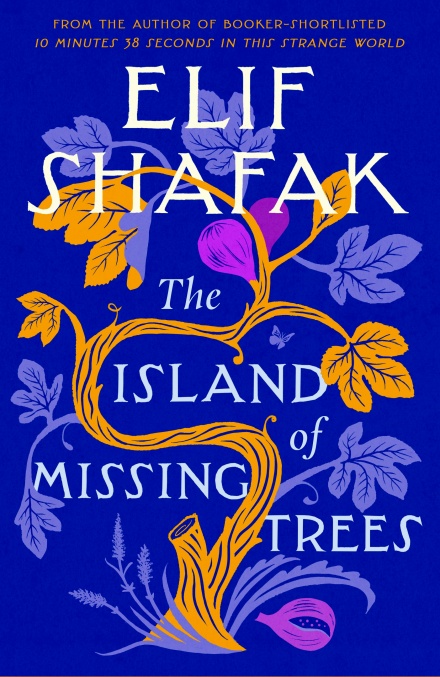
The Island of Missing Trees by Elif Shafak

07887F28-ED8F-4FCD-ACA3-D5CBA4BF013C

This was a bit of a spontaneous buy – reading just a few words about it in an email about new books made me think it would be one I’d enjoy. It turned out to be a book I loved. An extraordinary book that’s sad, inspiring, magical and wise. It’s about enduring love; what it means to be an immigrant, someone not living in the country in which you were born; it’s about family history and the passing on or denial of the past.

Elik Shafak is a British-Turkish prize-winning author. The Island of Missing Trees centres around the story of Cyprus and its divisions after the Turkish invasion of 1974, which led to the island being divided into Turkish Cyprus to the north and Greek Cyprus to the south. Before this, the tensions between the Turks and the Greeks was already difficult enough that two young lovers – the Turkish-Muslim Defne and the Greek-Christian Kostas – had to keep their love secret from their families who, if they knew, would disown them.

‘Once upon a memory’ opens the book, ‘lay an island so beautiful … that many travellers … fell in love with it … wanted never to leave or tried to tow it with hemp ropes all the way back to their own countries.’ Such beautiful language makes the tragedy of the battles and divisions that have raged throughout Cyprus for generations all the more vivid and haunting.

The story, however, opens in London with Ada, 16-year-old daughter of Defne and Kostas, who when asked by her teacher about family heirlooms can’t answer, and then starts screaming. Is she screaming because her mother recently died? Is she screaming because her father has been consumed by his grief and become distant from her? Or is she screaming because of all the untold stories, secrets, ghosts and tragedies of generations that lay hidden within her?

The Island of Missing Trees follows Defne and Kostas’ story through Ada, a girl born in London with all traces of her Cypriot heritage apparently wiped away but desperate to be recognised. Much of the story is told through a fig tree (which narrates alternate chapters), grown from a cutting of a tree that stood in the middle of The Happy Fig taverna in Nicosia. A tree that has witnessed all. In 1974 the taverna was run by a gay couple – one Greek Cypriot, one Turkish Cypriot – who were more at risk of discovery than even the young lovers. It was a happy place ‘despite the tensions and troubles besetting the island … It was a place with history and small miracles of its own.’ Yusef and Yiorgos help the young lovers, giving them a quiet corner of the taverna where they won’t be seen. The men are their protectors – but there’s no one to protect them when violence breaks out …

Kostas is persuaded to go to London in 1974 to escape the danger in Cyprus, told it’s only temporary, but  really for good. He writes to Defne but she doesn’t write back. More than 20 years pass but Kostas can’t forget his first and true love. By now he’s become a well-respected botanist and when his work takes him to Cyprus again, he knows he has to find out what happened to Defne. She is working as an archaeologist digging up the remains of all those who died in the war so that the lost are identified, the families can make peace. Or do they make peace? Should some things be left alone?

Despite Defne’s initial reluctance the two become a couple again … secrets, heartbreaks are shared. Both move to London, Defne already pregnant with Ada. It should be ‘happy ever after’ but in real life this rarely happens, and nor does it here. Defne becomes an alcoholic, she can’t forget the past and is haunted by ghosts and the loss of her own country, by the family who rejected her. She and Kostas agree to never speak of the past, of their families, so Ada grows up in ignorance of her heritage, her culture, her wider family. A decision made with love but also ignorance of our need to know where we came from, who we are.

Meanwhile, through the fig tree, the family’s story is told through a weaving of nature: of trees and plants, or animals and insects. It’s a wondrous tale of the continuity and connections in life.

I really loved this book: a book which is sad and troubling but also one of hope and delight.