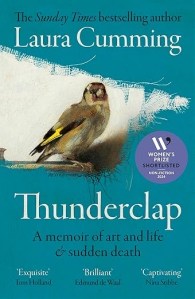
I recently came across this book on an excellent book blog I follow in which Susan Osborne wrote about the books she was currently reading (click here). It was a short review – she was still reading it – but there was enough to attract my attention and immediately get a copy of the book myself.
The book was shortlisted for the Women’s Prize Non-Fiction 2024. It’s rare for me to read non-fiction, apart from travel and cookery books, which is slightly ironic as in the far back days when I was working in book publishing full time and a commissioning editor, I was a non-fiction editor … Nowadays, I rarely even edit non-fiction books and generally prefer working on fiction titles. So, what attracted me to this book?
First of all, the art connection. Laura Cumming has been the Observer‘s chief art critic since 1999. I have a strong interest in art, frequently visiting galleries, occasionally doing short courses and going to lectures and talks (I’ve just booked two at the National Gallery). Another connection was The Netherlands and the Dutch Golden Age with artists like Rembrandt and Vermeer, and I was attracted to the story within the book being set in Delft, a town I’ve visited many times, and love. And to confirm my interest, Carel Fabritius’ glorious painting of The Goldfinch graces the cover.
I remember seeing a major exhibition of Vermeer’s painting in The Hague in the 1990s. I don’t think I was particularly interested in Vermeer at the time but it was ‘the exhibition to see’, so we went. It confirmed what I’ve thought so many times: those familiar, ‘chocolate box’ paintings we are so familiar with become something so much more when seen for real. To stand in front of them and really see them; really connect with them. The way they draw you in; what you feel. I still have a large print of The Kitchenmaid, slowly pouring her milk into a bowl, bought at that exhibition, in my study where I work. How could you look at it and not feel calm; not slow down? And after that, I went many times to Delft, and how could one go to Delft and not think of Vermeer. I just wish I’d known about Fabritius at the time too.
Thunderclap refers to the devastating gunpowder explosion in Delft on 12 October 1654. Much of the town was destroyed in an instant, and many died – including Fabritius, aged just 32.
Carel Fabritius lies at the heart of the story but so too does Laura’s Scottish father, James Cumming, an artist. Laura interweaves her love and fascination with Dutch art, Fabritius’ art and her father’s art, but also both Fabritius and her father’s lives and early deaths. The book is subtitled: ‘A memoir of art and life & sudden death’.
The book opens with a visit to the National Gallery in London where Laura likes to go to see Fabritius’ A View of Delft, With a Musical Instrument Seller’s Stall. ‘It has to me the atmosphere of a memory or a waking dream.’ The painting becomes ‘a kind of staging post’ when Laura first arrives in London: ‘It speaks of solitude in the city, of hoping for life to begin’. The way we look at art, at a painting, is unique: ‘There is no work of art so transcendent that it is not susceptible to our individuality.’ And when we visit a particular painting many times, our reaction to it changes as our lives and our experiences change us. Each time there is something new to take from the painting: ‘Artists enlarge our world.’
Laura’s love of art comes very much from her father, but also childhood visits to their doctor who gives her a postcard of Vermeer’s View of Delft and Fabritius’ The Goldfinch. The family visit The Netherlands, ‘the only trip we ever took abroad during my father’s lifetime’. In the Dutch paintings, full of everyday life, interiors, exteriors, Laura asks why so many people consider them as mere representations of the mundane, the ordinary. But she sees more: ‘The elements are so simple and joyous, the scene so modest yet exhilarating in its knowledge of the salty smoothness of the butter and the crisp crust of the roll, the relish of slicing that knife down through the ready cheese.’ Looking at a painting is less about admiring what it represents in a simple sense – an apple, a flower, etc. – but what it makes us feel in that moment.
We learn a lot about Fabritius in this book. Well, as much as is possible because myth and a lack of facts about him, means much is not known. There are gaps in our knowledge of his life. We don’t really know how many paintings he made and only a few are known to exist. His short life was filled with tragedy; he worked in Rembrandt’s studio; he was a near neighbour of Vermeer (who was also in Delft on the day of the Thunderclap but survived, unharmed).
I became fascinated with Fabritius too. I loved at the end we learnt that when The Goldfinch was restored in recent history, when X-rays and CT scans were available, it became obvious this beautiful painting was also harmed by the explosion, it was still drying, there were traces of the blast in minuscule indentations. The artist died but his painting lives on to enthral and delight us all.
I don’t think I will ever be able to look at art again in the way I did before reading this book. I thought I was pretty good at connecting to art but Laura Cumming teaches us there’s so much more to its appreciation. And I’m grateful for her words, her teaching and her passion.
 Kay Gale Editorial Services