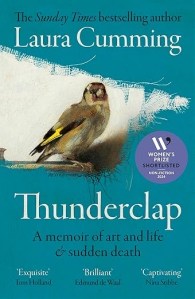
Thunderclap by Laura Cumming

I recently came across this book on an excellent book blog I follow in which Susan Osborne wrote about the books she was currently reading (click here). It was a short review – she was still reading it – but there was enough to attract my attention and immediately get a copy of the book myself.

The book was shortlisted for the Women’s Prize Non-Fiction 2024. It’s rare for me to read non-fiction, apart from travel and cookery books, which is slightly ironic as in the far back days when I was working in book publishing full time and a commissioning editor, I was a non-fiction editor … Nowadays, I rarely even edit non-fiction books and generally prefer working on fiction titles. So, what attracted me to this book?

First of all, the art connection. Laura Cumming has been the Observer‘s chief art critic since 1999. I have a strong interest in art, frequently visiting galleries, occasionally doing short courses and going to lectures and talks (I’ve just booked two at the National Gallery). Another connection was The Netherlands and the Dutch Golden Age with artists like Rembrandt and Vermeer, and I was attracted to the story within the book being set in Delft, a town I’ve visited many times, and love. And to confirm my interest, Carel Fabritius’ glorious painting of The Goldfinch graces the cover.

I remember seeing a major exhibition of Vermeer’s painting in The Hague in the 1990s. I don’t think I was particularly interested in Vermeer at the time but it was ‘the exhibition to see’, so we went. It confirmed what I’ve thought so many times: those familiar, ‘chocolate box’ paintings we are so familiar with become something so much more when seen for real. To stand in front of them and really see them; really connect with them. The way they draw you in; what you feel. I still have a large print of The Kitchenmaid, slowly pouring her milk into a bowl, bought at that exhibition, in my study where I work. How could you look at it and not feel calm; not slow down? And after that, I went many times to Delft, and how could one go to Delft and not think of Vermeer. I just wish I’d known about Fabritius at the time too.

Thunderclap refers to the devastating gunpowder explosion in Delft on 12 October 1654. Much of the town was destroyed in an instant, and many died – including Fabritius, aged just 32.

Carel Fabritius lies at the heart of the story but so too does Laura’s Scottish father, James Cumming, an artist. Laura interweaves her love and fascination with Dutch art, Fabritius’ art and her father’s art, but also both Fabritius and her father’s lives and early deaths. The book is subtitled: ‘A memoir of art and life & sudden death’.

The book opens with a visit to the National Gallery in London where Laura likes to go to see Fabritius’ A View of Delft, With a Musical Instrument Seller’s Stall. ‘It has to me the atmosphere of a memory or a waking dream.’ The painting becomes ‘a kind of staging post’ when Laura first arrives in London: ‘It speaks of solitude in the city, of hoping for life to begin’. The way we look at art, at a painting, is unique: ‘There is no work of art so transcendent that it is not susceptible to our individuality.’ And when we visit a particular painting many times, our reaction to it changes as our lives and our experiences change us. Each time there is something new to take from the painting: ‘Artists enlarge our world.’

Laura’s love of art comes very much from her father, but also childhood visits to their doctor who gives her a postcard of Vermeer’s View of Delft and Fabritius’ The Goldfinch. The family visit The Netherlands, ‘the only trip we ever took abroad during my father’s lifetime’. In the Dutch paintings, full of everyday life, interiors, exteriors, Laura asks why so many people consider them as mere representations of the mundane, the ordinary. But she sees more: ‘The elements are so simple and joyous, the scene so modest yet exhilarating in its knowledge of the salty smoothness of the butter and the crisp crust of the roll, the relish of slicing that knife down through the ready cheese.’ Looking at a painting is less about admiring what it represents in a simple sense – an apple, a flower, etc. – but what it makes us feel in that moment.

We learn a lot about Fabritius in this book. Well, as much as is possible because myth and a lack of facts about him, means much is not known. There are gaps in our knowledge of his life. We don’t really know how many paintings he made and only a few are known to exist. His short life was filled with tragedy; he worked in Rembrandt’s studio; he was a near neighbour of Vermeer (who was also in Delft on the day of the Thunderclap but survived, unharmed).

I became fascinated with Fabritius too. I loved at the end we learnt that when The Goldfinch was restored in recent history, when X-rays and CT scans were available, it became obvious this beautiful painting was also harmed by the explosion, it was still drying, there were traces of the blast in minuscule indentations. The artist died but his painting lives on to enthral and delight us all.

I don’t think I will ever be able to look at art again in the way I did before reading this book. I thought I was pretty good at connecting to art but Laura Cumming teaches us there’s so much more to its appreciation. And I’m grateful for her words, her teaching and her passion.


A Long Winter by Colm Toibin

This tiny book – I won’t call it a ‘novella’ as Tóibín is rather dismissive of that label (‘a novella is something no one wants’), though I’d have to disagree as novellas, like short stories, can be wonderful things – was a present from my friend Tina. I took it with me when I went out for coffee and some shopping yesterday morning. Normally on Sunday I like to have a coffee and then go for a walk round Richmond Green, maybe to the river, before the shops open (late on Sundays). But the rain, which has fallen relentlessly here in London for days, put paid to that routine and so I took my new book and decided I’d just take more time over coffee and have a good read. Good read! By the time I’d reached the end of the longish first chapter, I felt this wasn’t just a ‘good read’, it was a perfect read, a completely magical gem.

In a long Afterward at the end of the book, Tóibín tells us the story was originally published in 2005 at the end of his book Mothers and Sons and then as a separate book in 2025. He also describes how the story came to be written, based on his experience in Catalonia in the winter and a true story he heard there when trying to buy some land. I worked in longhand every day … the very weather of the story was happening outside my window. It may be a very short book but this Afterward is a fascinating insight into the time, thought and experience that Tóibín put into writing it.

The story is set in the high mountains of the Pyrenees one winter. Miguel’s family are preparing for the departure of his younger brother Jordi to go off for his two years’ national service. Miguel had managed to laugh to please his father, a role normally played by Jordi … but Jordi seldom spoke now. The family go into town to the market and while Jordi is taken for his military haircut by his father, Miquel goes to buy provisions with his mother. It is when she goes off on her own and he then tries to find her, he discovers her secret … she is in a bar downing tumblers of wine … his mother is an alcoholic.

Back home, he becomes aware of the signs he’s missed, realises this happened when he was away on national service but no one told him: In keeping the secret, they had treated him like a stranger. We learn of the hostility to the family since his father denounced some local families who diverted water in the summer months, effectively stealing from others, and while the rest of the village spoke in their defence, Miquel’s father took them to court where they were fined. This sense of isolation, of tension and things unsaid, grows as Jordi prepares to leave and is then gone. Miquel is troubled by the empty twin bed close to his; his brother’s absence.

When the father intercepts a delivery of wine his wife has secretly ordered and throws it all away, she becomes silently distraught, sitting hugging herself and rocking. Miguel’s father is determined she’ll just have to get used to it; there is no understanding, no compassion. Miguel tries to persuade him to buy her a little more but no. That’s not going to happen. Then … the mother disappears. While Miguel and his father are working repairing a barn one day, she puts on a coat and walks away and disappears. Heavy snow falls just as she goes. A few neighbours saw her walking away, it’s suspected she may be heading for her brother’s in another village. But the weather is turning too bad for her to get far …

Over the winter, cruel months of deep snow when travel is impossible, Miguel and his father must come to terms with the mother’s disappearance. Can they dare to hope she might have made it to her brother’s? Should they let Jordi know? Miguel is forced to take over the running of the house, look after the chickens, but he has no idea how to do it all and his father just complains at his attempts. When Miguel thought about his mother the feelings were sharpened by guilt … He knew that if he’d been brave he could have prevented her from leaving. He should have been braver in confronting his father.

Then his father comes back one day with Manolo. An orphan who is being given a home in return for him running the house. Manolo turns out to be great at it: he’s a good cook, the chickens start laying eggs again. He says little until one day, when Miguel’s father is taunting him yet again for his ‘womanly’ skills and says he should wear a skirt, Manolo turns on him and quietly threatens to leave if he says this again. Miguel, at first put out by Manolo’s presence, his use of Jordi’s bed, comes to form a warm and close bond with him. And there is a hint of love …

The story ends with the arrival of spring. It heralds change. Will Miguel’s mother’s body be found? Is it time for Miguel to allow grief, accept the loss? He watches his father shoot a bird, The dying bird was beyond human in its grief … Manolo held him hard, and in this moment of horror and grief there is hope for the future.

This is a truly beautiful read. Tóibìn’s elegant writing is a joy in itself, but this is a story that, despite its brevity, is full of strong emotion and powerful characters.


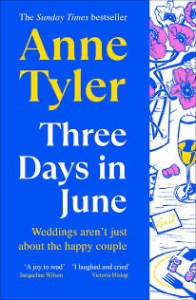
Three Days in June by Anne Tyler

This was a totally spontaneous buy. I was shopping for food in Waitrose yesterday and took a quick look at their book selection – located in the frozen food aisle! – as I passed by. And there it was: a new Anne Tyler book I hadn’t seen before. Waitrose sell only a very few books but I’ve bought some there recently as they seem to always sell most of them at reduced a price, especially the £9.99 paperbacks, like this one, for £6.99. To be honest, it didn’t need it to be reduced for me to want it. I’ve been a big Anne Tyler fan for many years.

I was hooked on Tyler’s books after reading Dinner at the Homesick Restaurant (pub. 1982), Tyler’s 9th book of 25 published novels, and which was a finalist for the Pulitzer Prize. It’s said she considers it her best novel. I must have read the paperback version soon after it came out and when my two children were toddler and baby. Why it stuck in my mind is the woman in the book thinks of how she had her first child and then had so much anxiety about it, worrying something would happen to her baby, that she thought the best thing was to have another. But, of course, and as she found out, the anxiety doesn’t lessen – you just have twice as much! This is a woman who understands, I thought, and it so much resonated with me that I have read many more of her books over the years. Like all ‘favourite authors’, other books I loved; some not quite so much. But I’m still enough of a fan to want to read a new one.

Tyler is a master of the ordinary. Her characters are ordinary people, living ordinary lives, in ordinary towns. Many of the novels are set in Baltimore, Maryland, where Tyler has lived for many years. She came from a family of Quakers, living in a Quaker community as a child, and didn’t go to public school until she was 11. She has said she always felt an outsider but that this meant she was able to view ‘the normal world with a certain amount of distance and surprise’. She’s still a very private person who rarely gives interviews, but this doesn’t stop her from developing her characters fully, with a deep empathy and understanding of the experiences and challenges, and loves and dreams that shape us all.

Three Days in June is a very short novel – just 165 pages. I’m not quite sure what constitutes a book being called a ‘novella’ rather than a ‘novel’ but I read this in a few short hours today. And I loved it.

The three days of the title are the day before, the day of, and the day after Gail’s daughter’s wedding. Gail, aged 61, is an assistant (deputy head) to the headmistress of a local school. The day before Debbie’s wedding she’s told that the head is planning to retire and not offer the job to Gail and perhaps it’s time for Gail to think of retiring or doing something else. Shocked, Gail walks straight out of the school and goes home to find her ex, Max, wanting to stay with her. He can’t, as planned, stay at their daughter’s and her fiancé’s place because he has a rescue cat with him and Debbie’s fiancé Kenneth is badly allergic to cats.

Gail is someone who likes to always be in control of her feelings, to have everything, including in her house, in perfect order. The head at school has just accused her of not being suitable for the headship because she has poor people skills. Into this devastating situation, Max comes with his usual disorder – and a cat! Though long divorced and not exactly friends, they seem to get along well enough in their familiarity of each other. Max with his easier going ways has a better relationship with Debbie and Gail often feels left out. Indeed she is left out of the wedding plans, not invited to Debbie’s pre-wedding spa day, although Kenneth’s mother is. Then, suddenly, that first day, Debbie tells them she can’t marry Kenneth after all. His sister has – at the spa day! – told her about his recent affair …

This becomes a challenging issue between Gail and Max. Gail thinks Debbie can’t marry a man who she already knows she can’t trust. And when Debbie comes back from seeing Kenneth after hearing his denial and explanation that there had been a misunderstanding, should they believe it? Does Debbie really believe it? Max urges Gail to let Debbie decide what to do for herself and as the story unfolds, unexpected past events are revealed, and Gail and Max are forced to reassess their own relationship after many years.

I don’t want to give too much away, but Tyler creates such strong and engaging characters, characters who may lead very different lives to you but you can recognise their experiences and feel with them, and that makes her stories compelling. Three Days in June is Anne Tyler at her best.


The Ferryman & His Wife by Frode Grytten

When I bought this book last week in my local Waterstones, the sales assistant told me how much she’d loved reading it and it would make me cry. Well yes, there is sadness here, but it’s also wonderfully life affirming. The novel is a kind of meditation on life, told by ferryman Nils Vik as he sets sail for the last time in his boat across the Norwegian fjord that has been his home for his whole life. He knows this will be his last day on earth and he meets all the people who have been important to him: passengers, family, friends and, most important of all, his wife Marta.

Over the fjord he goes … This is how his last day begins. Standing at the wheel , listening to the past ... ‘ He wonders, ‘Is that the dead coming through the openings of the forest? Yes, here they come.’

When the book opens we see Nils tidying his house, throwing things away, leaving it ready for his daughters when he’s gone. He even burns his mattress: ‘The mattress told the story of his entire life. It felt too private to allow other people … to deal with their past.’

On his journey, Nils is accompanied by the ghost (although the word ‘ghost’ is never used) of his old, faithful dog, Luna, who talks to him. Nils picks up dead people on his way, people who have made an impact on his life in some way: passengers going to work, going to church; doctors and midwives; teachers; young lovers; unhappy kids. He also meets his troubled younger brother, and he remembers his daughters (still alive). His boat provides a ‘little waiting room in time for people‘ who open themselves to him. He provides a calm and compassionate presence to others and the author has created this character so well, we too, as readers, are drawn to him: a man both very ordinary and very special.

We see both Nils’ joys and his challenges as he revisits his journey through life. And what of Marta? The ‘wife’ in the title? This is a relationship which gives him both joy and challenge.

This is a wonderful read. The writing is beautiful, lyrical, and the story is a profound telling of life itself, its ups and downs; the ordinariness of life and its uniqueness in every living soul.


A Family Matter by Claire Lynch

I was filling in time before meeting a friend for an early supper  at The Palomar. When I’m in the Piccadilly area I always like to allow time to go into Waterstones. Housed in an Art Deco building, it’s the largest bookshop in Europe. It has a fantastic travel section in the basement, where you’ll also find a good cafe. But stepping into the ground floor from Piccadilly, it’s easy to get caught up in browsing the shelves and tables packed with enticing books. I was attracted to A Family Matter by the blurb on the back and seeing that it was shortlisted for the Nero Book Awards in 2025. It’s also quite a short book, almost a novella. It’s not that I’m averse to reading long books, but when I’m busy with my book publishing work, I like to have a short book to delve into for a quick fix of a good read. My work generally provides lots of good reads, but reading something I’ve picked up in a bookstore, chosen and paid for is a different kind of delight.

I’m always intrigued by family set-ups, how they work, different relationships. A Family Matter moves between two times: 1982 and 2022. It opens in the later time and Heron (really Henry but always known as Heron) finds out he has cancer and a limited time to live. He contemplates not only the reality of knowing he will soon meet death, but how his life will now be otherwise changed, and how it will be when he tells his daughter, Maggie. They talk on the phone daily, though Maggie is now a 43-year-old mother of two (Tom, 14, and Olivia, 8) and married to Conor, but for a long time it was just the two of them and the bond holds.

Then the narrative moves back 40 years to Dawn, Maggie’s mother. When Dawn meets Hazel, suddenly her dull and predictable life is filled with exciting possibilities … but there’s no way she can envisage just how this new friendship, this new love, will change her life so dramatically, and the price she’ll have to pay for straying from the ‘norm’ and ‘accepted’ of the 1980s.

Maggie can barely remember her mother. She was only three when Dawn went out of her life; a loss that was never explained to her; a loss that she’s never been able to discuss with her father. But when Heron starts sorting though years of papers and documents, trying to tidy his life before it’s too late, and Maggie helps him, she comes across papers that completely upend the life she’s known. She’s never been able to accept that her mother abandoned her, it’s affected her own mothering, how she is with her kids, how she tries to be everything she wishes she’d had from a mother. And now … now she sees how she’s been deceived and she and her father must negotiate a new path in their relationship before he dies.

Back in the 1980s it was almost impossible for a lesbian mother to gain custody of her child when a marriage to the child’s father ended. Claire Lynch details the law at the time in an Author’s Note at the end of the book and the details of how the mothers were viewed is shocking. There’s a lot to be shocked by in A Family Matter. There is grief, but love too. There is misunderstanding and there is confusion. Both Heron and Conor tell Maggie, they were different times. And indeed they were. But to what extent does this excuse Heron’s behaviour or indeed, Dawn’s – had she tried hard enough to keep contact with Maggie. It’s a complex story of strong emotions but it’s also beautifully written and I found myself completely caught up and could barely put the book down till I’d finished (so perhaps it was a good job it’s quite short!).