April in Spain by John Banville

12F3AB31-71C4-4E42-80C3-D3ED3FA0D593_4_5005_c

I’ve just read another John Banville crime novel. It was this latest one that first interested me when I read a review and then I ended up also buying the preceding novel, Snow, to read first (click here for my review). I was also attracted by its setting in San Sebastian, Spain, a place I’ve visited and really like (see my food & travel blog: 48 Hours in San Sebastian). Who couldn’t be tempted to be transported to a bit of Spanish sun during these dull and grey winter days, albeit virtually.

April in Spain is another Detective Inspector Strafford novel set in the late 1950s, but in this one, Strafford takes a back seat and plays only a small part, and it is Dublin pathologist Quirke on whom the story centres. Quirke is on holiday in San Sebastian with his wife Evelyn, a psychiatrist. It is a second marriage for both and rather a strange match. Quirke, an alcoholic who has got his drinking almost under control, is often petulant and cantankerous and holds dark secrets about his orphanage childhood. He is not an immediately likeable character. Evelyn, is an Austrian who survived the Holocaust and refuses to talk, even to him, of her tragic past; she is not easy to like either. Their relationship has a combative edge, she the cool psychiatrist who always has to have the last word; he the bad-tempered and difficult man. Yet Banville creates a portrait of a loving and gentle relationship that makes sense of the marriage and forms an engaging thread to the novel.

Quirke is like a sulky child in his behaviour about being on holiday; he hates holidays. But then something very unexpected happens. When an accident (trying to shell oysters) takes him to the local A&E, he spies a woman doctor who seems familiar. She quickly disappears after seeing him and another doctor comes. It takes him a while to make the connection, but he feels certain this is the young woman, April, a friend of his daughter Phoebe, who supposedly died four years’ ago, murdered by her brother. When attempts to find out more about her prove impossible, he calls Phoebe who flies in from London to see if it really is her friend. But first she speaks to the police, and this sets in train a terrible and shocking set of consquences.

Strafford is sent with Phoebe – as a protector? To find out more? Meanwhile, we follow the story of Terry Trice, a hit man, who is also sent to Spain.

Behind April’s story lies a tale of incest, and political and moral corruption. These are themes that Banville likes to explore and which make his crime novels different – as well as his stylish and elegant writing. In Snow, it was the corruption and hypocrisy of the Catholic Church that came under his critical eye, this time it is the Irish state itself.

This is in no sense a genre ‘crime novel’. I’d describe it more as a novel in which there is a crime theme. While the ‘crime’ thread contains terrible stories of violence, abuse and corruption, it is not the kind of crime novel in which the reader can follow clues and hope to guess the murderer before the end. The ‘novel’ side, the part that is essentially Banville, contains wonderful insights into characters and their workings; a moving intimacy in the way the Quirkes’ marriage is drawn; and there are beautiful descriptions of its Spanish setting: ‘Darkness, when it fell, fell rapidly … they would stop and lean on the rail above the beach and gaze out over the bay, as black and shining as a vast bowl of oil and scattered with the reflections of lights from houses on the hill on the right, or from the little island of Santa Klara at the mouth of the  bay.’ Such descriptions took me right back to San Sebastian.

While there is something about Banville’s characters that I find slightly unreal and even at times clichéd, the book is so rich in its complexity, so beautifully written and engaging, that I found it – like Snow –  to be the kind of book you can hardly put down and want to keep on reading right to the end.

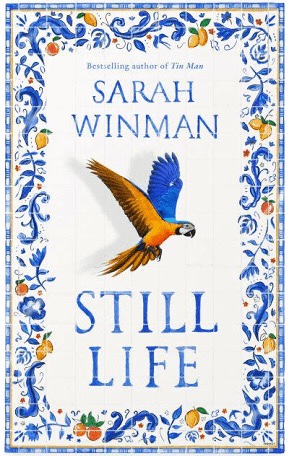
Still Life by Sarah Winman

881E5F89-95C8-4F57-AAD5-28ECF9F8A8DF_4_5005_c

I saw this book reviewed on BBC2’s Between the Covers, a book programme hosted by Sara Cox in which each week four guests join her to discuss their favourite books of all time and new books recently published. Last week they discussed Sarah Winman’s Still Life and I was hooked enough by what they said to order a copy immediately.

The reviewers all loved the book but it wasn’t just this that attracted me, but the theme of art and its meaning in our life, and the setting – of most of the novel – in Florence, Italy. The story begins in war-torn Europe in 1944 when a young British soldier, Ulysses Temper, meets Evelyn Skinner, an art historian, who has come to Italy to help save important artwork. Their meeting is brief but makes a huge impact on them both. This isn’t a story of romantic love between them but that visceral attraction we can feel towards another instantly; it’s about feeling a deep connection and seeing the world through the eyes of someone else and it changing us for ever. Evelyn is much older than Ulysses and gay; he is in love with the wife who will never return his love in the same way but their connection also runs deep enough for them to remain important people in each others’ lives, even once they’ve divorced.

I was pleased one of the TV reviewers said it took them a while to get into the book, for after the short beginning in 1944 Italy, the story moves to London’s East End where Ulysses has returned to take up his former life, and keep going his father’s business making beautiful globes. These aren’t the kind of cheap globes you buy kids to teach them geography, these are works of art, thus this is also another connection to Evelyn. Back home, wife Peg has had a baby – Alys – with an American soldier who seems to have deserted her – a theme of longing and the heartache of unrequited love that runs throughout the book. But Ulysses remains a friend, a rock, and another rock to them all is old Cress. Ulysses lives above Col’s pub; Col’s drinking and violence have caused his wife to leave and his instability rages throughout the story, but underneath his love for all those around him makes them continue to care about him.

This London period is when the characters are gathered – Ulysses, Peg, Alys, Col, Cress and piano Pete – and we witness the strong bond that ties them together. It was here that my interest waned a bit though before the big change: Ulysses inherits a large apartment in Florence. It has been left to him by Arturo, who in 1944 he rescued from a suicide attempt. Should he sell the apartment or go back to Florence? Uncertain at first, he then sets off with Cress in an old van, and with Alys. Peg finds motherhood too hard, cannot get over the pain of her daughter’s likeness to the missing father. Ulysses has become a father to Alys and so he takes her. They also take Claude, the parrot that lives in the pub and is constantly abused by Col but loved by all. Once in Florence, it soon becomes apparent they will stay, this will be their new home.

Florence brings new characters: Massimo the lawyer who handled Arturo’s will and is to become a close friend; Michele who runs the local restaurant. A whole cast of characters. Meanwhile, Evelyn is back lecturing in London but she hasn’t forgotten Ulysses. She comes to Florence a few times, the city she loves, and their paths almost cross but not quite. It will take many years before they are reunited. As Alys grows she shows huge talent as an artist, returns to London to art school, is touched by Evelyn’s lecturing, but the connection to Ulysses is not yet made …

There are a lot of coincidences, there is a lot of magic. In many ways the book is a fairy tale for the characters are larger than life and even the parrot talks – not just repeating words but words of wisdom; trees talk too. Ulysses’ inheritance is a kind of fairy tale; Cress has vivid visions of the future that result in him being able to place bets on, for example, Geoff Hurst getting a hat trick in the 1966 football World Cup, that make a huge amount of money but he’s also the source of spiritual wisdom and he tells them at one point that he was once a friar.

The years go by, loves are found and lost, friends are made. Florence has become Ulysses’ home and he opens a workshop to make globes again. It’s not until the great flood of 1966 that almost destroys Florence, that Ulysses and Evelyn are finally reunited: not as lovers but soul mates.

I ended up loving the book. Yes the characters are a little unreal; their experiences rely so often on convenient coincidence not to mention that magic I mentioned. But they are real to the reader in the sense that you come to really care about them. And the writing is beautiful with some glorious descriptions of Florence and life there. Winman adopts a conversational style that creates an intimacy with the reader and also a sense of wonder – just as every good fairy tale should do. It is a book about love of all kinds; of the deep bonds of friendship; the wonder of life and the unknown aspect of it. There is a spiritual, metaphysical dimension.

For me, it was also a delight to read a book set in Florence that centred around my favourite part of the city – Santo Spirito, in Oltrarno, the other side of the River Arno to the famous sites, a more bohemian area. I recognised the names of piazzas and roads and bridges, even the famous gelateria, Vivoli. Winman’s knowledge of food is superb and this also appealed. I could picture Piazza Santo Spirito so clearly, where my favourite restaurant, a simple Osteria, is the place I always want to head to first to eat (see my food & travel blog post: click here).

It was one of those books that will keep you up late at night and you are so sad when it ends, although memories of it stay with you.

Snow by John Banville

7EA3341C-330A-4962-B9DD-473865526B11_4_5005_c

I rarely buy crime or thriller books to read ‘for pleasure’, as opposed to reading ‘for work’. I used to read, many years ago, crime books by P.D.James, Robert Goddard, and others. I’m not sure quite why I abandoned the genre but perhaps it was because many of my ‘work’ books – books I’m sent to edit or proofread – are this genre. I actually quite like working on them, have even enthusiastically requested that the author’s next book comes to me, but my ‘pleasure’ books, the ones I buy to read when work is slow and I have time, or am on holiday, have taken a different direction.

So what attracted me to read this crime story by John Banville? Partly, I think, because my last piece of editing work was a dystopian, post-pandemic novel which, rather than taking me into a world of escapism, took me instead into a worst-case scenario future. Perhaps there was something to be said for those crime stories after all – you know where you stand with a bit of old-fashioned blood and gore, a wily detective and a host of suspects. I also caught sight of a good review and was intrigued to read a John Banville book of this kind – so it was ordered.

I read John Banville’s Booker Prize winning novel The Sea when it was published to much acclaim back in 2005. Although I remember little of it (I’m not good at long-term memory when it comes to the details of books read years ago and am always in awe of those who are), I do clearly remember I thought it was brilliant. I know that Banville turned to writing crime under the pseudonym Benjamin Black, so it was interesting that he’d abandoned the well-used pseudonym for his real name with this book, despite it having the same setting and characters (though a change in central character). What was this fusion of genre writing with literary writing?

The fusion is a combination of an old-fashioned country house mystery – à la Agatha Christie – and a beautifully written story. 

Set in 1957 in Ireland, Detective Inspector St John Strafford is called from Dublin to investigate a murder at Ballyglass House in County Wexford. A body has been found in the library (think Cluedo!), and a cast of eccentric characters appear, all with some possible motive for killing the man. But the man isn’t just any man, he is a priest, and thus the power of the Catholic Church will play an important role in determining the outcome of Strafford’s investigation. 

So, a country house, a body and a host of suspects. But Strafford in no Hercule Poirot. Strafford is a man with his own demons; insecure; uncertain he’s cut out for police work; a loner who stands apart from the world. Even his inability to tolerate alcohol means he’s unable to socialise and be accepted as some kind of ‘ordinary’ man – it’s merely an embarrassing burden for him to bear. And there is the mystery of his aristocratic background and why he chose this police route rather than become a barrister as his father hoped. As we witness his agonised internal brooding, his surprising, even shocking susceptibility to a pretty woman, he seems in many ways very real, unlike the other characters in the book.

At Ballyglass House we find a stiff, privileged colonel; his drugged-up, much younger second wife who found the body but seems incapable of giving any coherent information; an unruly daughter; a hostile, arrogant son. Into the mix are thrown the local publican who quotes Shakespeare and Chaucer in ordinary conversation; a doctor who feels a need to visit the frail wife every day; the local police chief who drowns his grief at his son’s recent suicide in alcohol; and the stable boy, Fonsey, whose sad history and rough appearance hide more intelligence than is generally recognised. Which of them would kill Father Tom Lawless? The apparently well-liked and popular priest. Well, of course ‘Lawless’ gives us a clue …The hypocrisy, power and corruption of the Catholic Church at this time is laid bare. 

The crime aspect of Banville’s story follows the usual conventions. Strafford says a few times that it feels as if he is watching a play and all the suspects are characters in it. And in this sense, we see it too as a kind of play; unreal and full of clichéd characters. And the clues to what lies behind the murder are laid bare a little too early for the committed crime reader to play at sleuth. But it is Banville’s glorious writing, the vivid descriptions of the snow-covered land, his authentic creation of 1950s Ireland, his acute understanding of his characters, that makes this an entertaining and worthwhile read: ‘It had snowed continuously for two days, and this morning everything appeared to stand in hushed amazement before the spectacle of such expanses of unbroken whiteness on all sides.’ It was with a kind of hushed amazement that I reread many sentences to enjoy their beauty again.


What does a freelance book editor do?

img_0866

Most people’s jobs are a mystery to some extent. We may have an idea about what an accountant does, what a teacher does, what a plumber or a car mechanic does, but it’s usually just a rough overview of the basics. We’re mostly unaware of all the skills learnt and used; the day-to-day experience of actually doing the job.

There’s a certain glamour to saying you’re a book editor. People usually imagine you tucked up comfortably just reading a lot of lovely books with little idea of what we actually do. I’m not sure there’s much glamour in the freelance world of book editing, but when I was a full-time commissioning editor many years ago, well-known authors and personalities would come into my orbit and I have to admit to some excitement meeting many of them. As a freelancer such things are rare and mostly nowadays I don’t even meet – actually meet – the various editors and editorial assistants who contact me to offer work. Everything is done virtually via emails – they contact me about work which is sent either as a Word document for a copy-editing job or an Adobe PDF file for a set of proofs to correct.

I used to do a lot more reading work than I do now, though still occasionally manuscripts are sent for me to assess. I have to look at whether I think they’re good enough to be published, looking not only at how well written (or not!) they are but their commercial potential. A report requires not just a critical analysis of content and an assessment of how well it reads, but it’s important to offer constructive comments on how it might be improved, what work might need to be done before it would be seen as publishable.

Most of my work now is either copy-editing or proofreading. Let’s start with copy-editing as that stage comes earlier, though not first. The first stage ‘editing’, or ‘structural editing’, is usually done in-house – i.e. by the editor who has bought or commissioned the book. They will read it to see if more work needs to be done: perhaps it’s too long or too short; maybe some character or event in the book needs more clarity or expansion; maybe the main character needs to be expanded so we know more about them. In a book I worked on a few months’ ago a guy who’d appeared in an earlier book in the series had behaved badly. In the new book he was going to end up marrying a lovely central character and I said I thought the guy needed to be made nicer as the new book progressed or we wouldn’t want him marrying her!

Copy-editing a book involves not only correcting spelling and grammar but checking consistencies. If the book spans a few years, do people’s ages and years of events match up? As an editor you have to make notes and have a timeline to check against as you work. If real people or products, towns and cities, are mentioned, you need to check spelling. I just happened to find myself working on lots of thrillers featuring terrorists a while ago and had to keep checking the spelling of guns and weapons. I joked that if I was being ‘watched’ the terrorist squad would be at my door soon. You also have to check dates for historical events. To a certain extent it’s the author’s responsibility to make sure references to real people, places and events are correct, but as an editor you have to be ready to question anything that doesn’t sound right.

My age helps sometimes and I’m able to pick up things that a younger editor might easily miss, e.g. the current age at which you can claim your pension. I once years ago read a book set in Rome, which I know well, and immediately saw that a description of a major road in the centre of Rome was incorrect. Having walked along it many times, I knew it was very wide – not the narrow street described in the book. It turned out the author had relied on someone else for the description and had never actually been there.

Most of the books I work on have UK spelling but occasionally US, so I have to know or check some spellings which are different, like ‘kerb’ (UK) but ‘curb’ (US) for the pavement kind of kerb; a block of flats with five ‘storeys’ in UK, but ‘stories’ in US. As a copy-editor you make a style sheet and one will be sent to you for a proofread. Of course most spellings are standard but a few are down to choice or house style (i.e. the publisher’s preference). The important thing for the editor or proofreader is checking consistency, that the same spelling is used throughout.

A copy-editor also looks as ‘clunky’ sentences. I’m sure you know the kind of thing I mean, where a sentence is a bit too convoluted, unclear or simply goes on too long. You also look out for repetition – giving details in almost exactly the same way as earlier in the book.

I always read a book I’m copy-editing as a reader – someone who has bought the book – would do. I don’t skip to the end, I need to make sure everything makes sense as I go through, that things tie up and everything that needs to be explained – perhaps later in the story – is explained.

Once a book has been copy-edited and returned to the publisher, it’s usually looked at by the commissioning editor and the author. The author is given the chance to approve or not any changes; they will also look at and answer any queries.

Then the book is ready to go to the printer. The book is typeset and then sets of proofs made to be checked before actual printing.

As a proofreader you expect that most of the actual editing has been done in the earlier stages, but you might still question some repetition, a clunky sentence or note that some of the dates or events don’t match up. In essence you’re really checking for typos – errors that have occurred in the printing, but there will always be some ‘author’s errors’, things that have been missed at the copy-editing stage. Even an experienced copy-editor and proofreader won’t usually catch 100% of the mistakes and major books which are expected to be bestsellers are often sent to more than one proofreader, as well as being checked by the author.

I rarely work on a book that’s really awful as I work for major publishers and often the authors are well known or have had a number of books published already. Of course, they are not always books I’d actually buy to read for pleasure. This means I’m often working on books which are okay, and I’m happy enough working on them, but I wouldn’t have chosen to read. It also means though that I often find myself reading something I might not have chosen but really like, so it’s a nice surprise. The drawback, of course, to the books I don’t particularly like is that I have to read every word. But I’ve also found myself enjoying a read so much that I want to go on reading past my usual ‘stop work’ time but know I wouldn’t be able to sustain the concentration needed to do a good job for longer. The concentration required is for all described above but also includes things like noticing when a comma should be a full stop, or that a quote mark or apostrophe is the wrong way round – really minute detail. Both copy-editing and proofreading are jobs you can’t do non-stop for hours on end; you have to take regular breaks not just for your eyes but for your concentration. It’s not like working in an office where the day is usually a mix of things, with meetings and phone calls, chats with colleagues. Freelancing is truly head-down, high concentration stuff and over the many years I’ve been doing it, I’ve learnt of ways to break the day up and get a bit of light relief before I get back to the computer with full-on concentration again.

I’ve always loved reading, right from when I was a small child and reading my first books, so how lucky was I to find my way into work that enabled me to do something I’m passionate about.

The Magician by Colm Toibin

071BDC38-3D07-4009-83A6-9A7420355E9C_4_5005_c

I’ve admired and enjoyed Colm Toíbín’s work since reading Nora Webster (published 2014), and then Brooklyn, which was published earlier in 2009 but I read later. He has a remarkable gift for bringing his characters to life; a deep understanding of the workings of his characters’ inner life; telling a wonderful story. The Magician is different. It’s a novel based on the life of German author Thomas Mann. He’s taken this path before, writing The Master based on the life of writer Henry James. Clearly Toíbín has a fascination with other writers but for me his fictionalised biographies don’t work as well as the novels. I felt this about The Master, despite it receiving critical acclaim and being short-listed for the Booker Prize. But when I read brilliant reviews of The Magician, I felt I should give this genre a go again.

To begin with, I really enjoyed it. I remembered reading Mann’s novels in my twenties and of course even if you haven’t read Death in Venice, most people will know of the film. Its story has a clear link to Mann’s suppressed homosexuality and the theme is constantly referred to throughout. Toíbín himself is gay but at the time Mann was writing, it was not accepted and still illegal. This fits with an almost ideal marriage that Mann makes to Katia who is willing to love him as he is and indeed they have six children. Katia has a close relationship with her twin brother Klaus that hints of something sexual at times but is perhaps merely an intimacy that no one else can infiltrate. Towards the end of the book, she says she didn’t want to be married to someone like her father who had many affairs and she knew Thomas wouldn’t do this to her. What Toíbín so wonderful conveys is how this marriage, which is some ways one of convenience to them both, works so well and the love and affection between the couple comes clearly through.

From the beginning, Katia was brought up in a household full of drama ‘as if it were a modern play’ and this sense of drama continues through her own marriage and her family.

Thomas was brought up in a wealthy family with much privilege but when his father dies and he doesn’t inherit the family firm as he believed he would, and the family have to leave their home and he is forced to take a job as a clerk, he is devastated: ‘No matter where he went, he would never be important again.’ Of course, he became very important indeed through his writing and I hadn’t realised before reading this quite how important on the global stage, nor how much wealth his writing created for him. But this early experience seemed to mark Mann for life; he seems always an outsider, guarding his reputation beyond most other things, Katia his support and protector.

Thomas dismissed the threat of Hitler for a long time, refusing to speak out. Clearly to some extent he does believe the threat back in the early 1930s is exaggerated and Hitler may disappear as a nothing in the end, but even when the threat grows more real and Hitler comes to power, Thomas is reluctant to speak out. To an extent this is excused by his protection of his family and his publisher, but it is also about his reputation and wealth – his books would be destroyed.

Mann’s life is haunted by tragedy, particularly suicides of family members. At the outbreak of war he uses his reputation to secure a ticket out of Europe to America where he struggles to fit in; struggles with the ‘death’ of ‘his Germany’. There is great poignancy in the family’s loss of their country and it becomes impossible for them to fit in well elsewhere, find another true home.

The book gives a background to Thomas’s writing, both his habits (always writing in the morning) and within his mind, how experiences shape the novels he writes, which is fascinating, particularly if you know his work. It’s also a portrait of a rather dysfunctional man and family and I found it hard to engage with the characters. What began as promising for me, ended as rather a dull book and a little pedestrian in its description of Mann’s life, as if all the ‘facts’ had to be included, however small, and although in a biography (whether fictionalised or not) you don’t necessarily have to like the subject, they have to promote interest but by the end of this book I neither liked Mann nor could understand how he became such an admired writer.