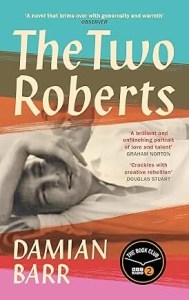
The Two Roberts by Damian Barr

I’ve been having a holiday from work over the Christmas period and enjoying having the time to read books of choice – books I’ve bought rather than ones I’m paid to edit. One of them is The Two Roberts by Damian Barr. I’d read a good review of it and was particularly attracted by the art connection: the book is about two artists who lived in the first half of the 20th century. The novel is based on the true lives of the artists Robert (Bobby) MacBryde and Robert Colquhoun and gives an insight not only into the art world of the time – many artists appear: Lucien Freud; Francis Bacon; John Milton (who illustrated Elizabeth David’s A Book of Mediterranean Food) – but the dangers of being gay at that time. With its beautiful, lyrical writing, it is also an ode to love: to love at first sight when Bobby first catches sight of Robert on a train; the enduring love that weathers the kind of wild life many artists lived at the time; separation during World War Two; artistic jealousy because Robert’s work is constantly judged better than Bobby’s. But above all, the love that survives the challenges and dangers of being gay at a time when it was illegal; a love that sees them rejected by their families and constantly in fear of discovery.

From early on their teacher at the prestigious Glasgow School of Art – from which they graduate as top students of their year – sees the two produce better work when they work together and for their whole lives they will be seen as a unit. But there’s pressure in this too, their professional and personal lives so intimately and strongly entwined: they cannot live without each other but they cannot always live in peace with each other and their fights and arguments become famous amongst those who know them.

I was immediately drawn in by the poetic writing: the opening when the two lovers are ‘curled like commas’; their tutor when they first meet him rubbing ‘his hands over an invisible fire’, which so vividly creates the image of how he looked. From their home towns in Scotland, the story follows them to London, Paris and Rome. They are celebrated as great artists but the cost is devastatingly high.

When the author Damian Barr came across the two Roberts’ story, he wanted to give them the recognition he felt they deserved, and in doing so has written a compelling, rich and absorbing novel. Apart from the story of the two men, the book provides a vivid social insight to the times, from the poor homes of small town Scotland to the hedonistic lives led in London’s Soho.

You Are Here by David Nicholls

I didn’t get on with Nicholls’ early books so have given him a miss in recent years. However, I was browsing Waitrose’s books – yes, Waitrose! My local branch has a small selection of books which are usually sold at a discounted price, £6.99 instead of £9.99 – and picked up You Are Here and thought, I really must give David Nicholls another go. I’m so glad I did for this was one of the best reads I’ve had in a while.

It is, essentially, a love story, which unfolds over the course of a few days’ coast-to-coast walk across the north of England from Cumbria in the West to North Yorkshire in the East. It’s organised by Cleo who brings together a small group of friends, including Marnie and Michael. Both are reeling from the aftermath of divorce (Marnie, aged 38) and separation (Michael, aged 42). Cleo is hellbent of matchmaking but she doesn’t imagine Marnie and Michael with each other – she has other people in mind for them.

Both Marnie and Michael have fallen into leading solitary lives. Friends have married, had children (they couldn’t in their marriages) and drifted away. Michael we learn, had an ‘accident’ – or was it a ‘fight’? – before his wife left him, which has left him both mentally and physically scarred. It’s not until near the end of the book that we learn the details. Marnie buries herself in her work as a freelance copy editor. As a freelance editor myself, I was slightly taken aback by how she almost never stopped working, even in pubs and on trains, and this was surely not just for the money she needed, but an escape from her solitude. But at the end of the first chapter we are told, ‘Sometimes, she thought, it’s easier to remain lonely than present the lonely person to the world … It was no good. She would have to go outside.’

Cleo’s matchmaking is so OTT that frankly it makes her come across as a bit of a bully and not particularly likeable. But this controlling need in her leads her to organise an ambitious and quite demanding walk for her friends and she also books their accommodation en route. Almost the entire book follows the walk and Michael and Marnie’s stories are told in alternate – quite short – chapters.

Michael is a keen walker. He’s a geography teacher and thus understands much about the terrain and its history and the teacher in him can’t always resist educating those around him. Normally he prefers to walk alone and in many ways it’s an escape from moving on in his life. Now, with Cleo’s friends in tow, he feels some responsibility as they are all novices and his instincts for solitude fight against trying to be part of a group.

Parts of the walk are quite brutal and gradually there’s only Michael and Marnie left. They annoy each other at first, they are so different in many ways, but inevitably (this is a love story, after all) something slowly stirs between them. But can it really work? Not only do they have to overcome their differences, but finally let go of their past relationships.

It’s a wonderful read both for the vivid descriptions of the stages of the walks – the villages and landscapes they pass through and (usually rather horrendous) places they stay at night – with the odd input of humour (mainly from Marnie). Nicholls has a deep understanding of his characters’ psyche, shows much empathy for them, and he’s appealingly philosophical about life. Thus the book is really much more than a love story, it’s about life itself, second chances, and is delightfully hopeful.

Gabriel’s Moon by William Boyd

This was a bit of a spontaneous buy. I was wandering around my local Waterstones looking for a book to fill a gap between work. Sometimes when I’m deep in a book editing job and have to hold a lot in my head as well as make notes, I find it too distracting to get deeply into a book I’ve bought as well, so little gaps in work are a welcome chance to buy a book of choice.

I was a great fan of Boyd’s early work – An Ice-Cream War, Brazzaville Beach, etc. – but haven’t taken to later books quite so well. However, here before me was a paperback of his latest book, Gabriel’s Moon, the cover full of enthusiastic reviews praising his storytelling, with an intriguing sounding ‘tale of globe-trotting adventure (Guardian)’ so I decided to give it a go.

Gabriel and I got off to a good start, the title of the book soon being explained as 6-year-old Gabriel’s night light – a glass moon globe – features in the opening paragraphs … and then is blamed for a terrible house fire that completely destroys his home, kills his mother (his father is already dead) and leaves him an orphan. We quickly jump 24 years. Gabriel is starting to make a name for himself as a travel writer; he has a cordial but fairly shallow relationship with his older brother Sefton, a civil servant; he lives alone and has a girlfriend who is fun with whom he has great sex, but she’s not someone he wants to be with for ever. Gabriel clearly has commitment problems. He suffers from severe insomnia which leads him to seek help from a psychoanalyst. With his regular nightmares of fires, it seems the house fire of his childhood must have more significance than he’s aware of and he thinks if he’s able to remember more of the night and what happened – memories he’s obviously shut down – he may be able to solve his sleep problem.

Soon though, we see him manipulated into a world of espionage. This is 1960 .. the time of the Cold War … the nuclear threat in Cuba. When Gabriel makes a trip to the newly independent Republic of Congo, his travel writing takes a political turn when he’s unexpectedly given the chance to interview the new president, who is murdered quite soon after. The interview leads him into a dark and dangerous world; a world of duplicity and deception. Suddenly it’s hard to know who he can trust: is his brother really a straightforward civil servant or a spy? Are the editors and agents who find him work more than they seem? What of the psychoanalyst who confesses she doesn’t actually have any qualifications, though seems to help him? And what of his MI6 handler, Faith, who clearly can’t be trusted to tell him the truth but who he becomes more and more obsessed with and attracted to.

The novel becomes increasingly complex as Gabriel travels around the world, trying to write a new travel book while at the same time fulfilling jobs for Faith that are ever more dangerous. New people are introduced and he’s drawn more deeply into the world of spies and no one is quite what they seem. For me, there is clever complexity in the world of books and tedious complexity. Gabriel seemed increasingly to be drawn into the world of spies through naivety rather than chance or purpose. He wasn’t really a character I could admire. We don’t always have to like characters but we need to admire the ones around whom a story is based; even if they are not good people, are evil people even, there has to be some kind of strength in them that makes reading the story worthwhile; for it to make sense. Gabriel’s Moon made less and less sense as it went on. Too many intriguing possibilities were introduced but never resolved. Even the Moon: I kept feeling that there must be some kind of link to the spy story and it seemed not. Though perhaps the fire experience made Gabriel into the man who was vulnerable enough to be manipulated so badly.

Most of the reviews of this book are full of praise, though I did find the odd one more in line with my own thoughts. Some suggested that the unsatisfactory ending left things open for a sequel – but leaving books open for a sequel isn’t supposed to happen like that. You’re supposed to think the ending, the book, is so brilliant you want more. I like reading thrillers; I like reading crime novels … maybe I’m not a spy book person. But this novel left me not just cold, but hugely frustrated by its rather scattered storyline, unsatisfactory ending and unattractive characters.

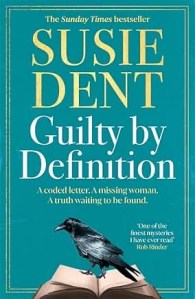
Guilty by Definition by Susie Dent

This was another of my spontaneous buys. I’m most tempted by books to buy when I’ve a gap in my publishing work or I’m working on a non-fiction book, as I’ve done over the past week. Sometimes I find it difficult to read a novel of choice – one I’ve bought – alongside one I’m editing. When editing, you need to immerse yourself deeply in the story and while I make lots of notes, there are always inconsistencies or questions that pop up as I go along, and much has to be held in one’s head.

I saw Guilty by Definition in my local Waterstones. I recognised the name of the author – even though I don’t watch Countdown on TV – and knew she was a ‘word’ expert. Well, how can a book editor resist a debut novel by a word expert! Especially a book that centres on words: their meaning now and their origins and original meaning.

But this is also, and primarily, a crime story, which is set within the offices of a dictionary – Clarendon English Dictionary (CED) – based in Oxford. The senior editor Martha Thornhill has just returned from living in Berlin. Quite why she’s come back now is one of the mysteries but a far bigger one is the disappearance of her older sister, Charlie (Charlotte), ten years ago.

Martha is living with her father, Gabriel; her mother has recently died. There are all kinds of unspoken tensions between them connected to Charlie’s disappearance. Charlie was the beautiful, exceptionally bright daughter; Martha lived in her shadow. Her mother never gave up believing that Charlie was still alive somewhere and would one day come back.

Into this uneasy situation comes ‘Chorus’. Letters, signed ‘Chorus’, start arriving at the CED offices. The letters are hard to decipher. A knowledge of linguistics, Shakespeare and an aptitude for solving crosswords helps. Then it turns out that there are postcards too, some from years ago, which are being sent to anyone connected to the CED (Charlie briefly worked there), even Safi who is relatively new and was still at school when Charlie disappeared. Dates and information in the letters make it obvious that they are about Charlie and perhaps hold the answer to what happened to her.

Reluctantly, Martha realises she must find out more about her missing sister. She also has the guilty feelings and grief that have haunted her for ten years to contend with, but it soon becomes obvious that more people are connected to Charlie and her disappearance than she’d ever realised. Helped by her colleagues Safi, Alex and Simon, they decipher the message hidden in each of the letters and are soon investigating various leads which they hope will solve mystery.

Martha has always thought the best of Charlie – that she was bright, well-loved and respected. But she quickly has to face the truth of there being a darker side to her sister. Why did A-student Charlie suddenly stop working properly on her PhD? What was the book she said she was writing and where is it? When she was working for a second-hand bookseller, was she really syphoning off the best finds at auctions and selling them herself and not declaring them to her boss?

There are many twists and red herrings and I really didn’t know (as in the best crime books) how it would all resolve until the end. We are caught in a wonderful unravelling of secrets and mysteries as the story unfolds. What happened to Charlie? Was she murdered? Or is she still alive somewhere? And who, crucially, is Chorus? And why are they sending the letters? What do they know?

Each chapter is headed with an old word, e.g.: mathom, noun, (Old English), which means ‘a precious thing; a valuable gift’. Within the text, words and their origins and meanings are also discussed. I liked ‘a tidsoptimist‘ – ‘It’s Swedish. A time optimist.’

At the heart of the story though, is the growing possibility that Charlie discovered a ‘commonplace book’ when she was at an auction, dating as far back as Shakespeare. If she did, and if it was written by who it becomes increasingly likely to have been, it would be a huge find. As big as Tutankhamun we are told. A find you could be murdered for …

I loved all the mystery; I loved the words; I loved the excitement of a huge literary find and what it feels like to be involved in it. But Susie Dent has also created some strong characters who each have their own stories as well as their connection to Charlie, so you really engage with them. I don’t want to give too much away. It’s a great read. The cover quotes Rob Rinder as saying, ‘One of the finest mysteries I have ever read.’ And it’s certainly one of the best I’ve read too … different to the standard crime book and all the more exciting for its originality.

Claire Keegan: Small Things Like These

There was a touch of serendipity to my coming to read this book. I finished a publishing job at lunchtime, the sun came out, I decided to head down to the high street and take a walk along the Thames. Then I thought, well, it would be nice to grab an afternoon coffee somewhere but I need something to read … so I headed into Waterstone’s and it was Claire Keegan’s book that took my eye from the pile on the table. It looked familiar; maybe I’d read it before? But no, I hadn’t. It was published in 2021 and shortlisted for the Booker Prize in 2022. It’s short – a mere 116 pages – but as we all know, small can be beautiful and this book was so stunningly good that when I finished it last night just before bedtime, I was left in awe of its power and took my thoughts about it to bed with me.

Set in Ireland in 1985 in the run-up to Christmas, the weather is bitter. Keegan’s opening beautifully  evokes the season: ‘In October there were yellow trees. Then … the long November winds came … and stripped the trees bare … the River Barrow, dark as stout, swelled up with rain. The people … unhappily endured the weather.’ 

We meet Bill Furlong, a coal merchant, and it’s his busiest time of year. Bill, we are told, ‘came from nothing’. His mother fell pregnant at the age of 16 and when her family disown her, her employer, a widow Mrs Wilson, keeps her on as a domestic in her large house on the edge of town and gives her and her baby, born in April 1946, a home. Mrs Wilson takes the growing Bill under her wing, teaching him to read and continuing to give him a home when his mother dies while he’s still young. Later, when Bill marries Eileen, Mrs Wilson gives them a generous amount of money to get them started in their life together, and they go on to have five daughters.

The generous, kind and unprejudiced behaviour of Mrs Wilson to Bill and his mother lies at the heart of this story and shapes Bill’s choices. It’s based on the real history of the Magdalene laundries, run by Roman Catholic institutions, where pregnant women, or women seen as promiscuous, were incarcerated for life, made to work for no money and were appallingly treated. They operated from 1922 until – quite shockingly – 1996.

At the beginning of the book, Bill is ‘disinclined to dwell on the past’. He’s attracted to Eileen’s ‘practical, agile mind’ but we soon see that she’s less forgiving of poverty than Bill and scolds him when he gives money or free coal to those in need. When they disagree on things like this, he lies awake at night ‘going over small things like these‘. These ‘small things’ are a seed though and an incident will cause Bill mental turmoil as he struggles with a moral choice and is forced to look at his past. 

When making a delivery to the local convent, which has a laundry, he finds himself in a small chapel and sees girls scrubbing the floor on their hands and knees. One of them begs him to help her escape; she would rather drown herself in the nearby river than stay there. But then he’s distracted by one of the nuns coming and is taken away. However, he can’t forget the experience and it plays on his mind. The next time he finds a girl in the coal shed, obviously left there as a punishment, and takes her to the house. The Mother Superior glosses over it, suggests it was all a mistake and makes a show of being kind to the girl. Bill doesn’t believe it though. He’s now confronted with his own past, the knowledge that if it hadn’t been for Mrs Wilson, then his own mother would have been treated like this girl and what would have happened to him.

The locals hear about the incident and it’s obvious that they won’t accept him challenging the nuns. It’s clear everyone knows what goes on at the laundry but the nuns are generous and no one wants to upset them. Eileen doesn’t want him to do anything. She cruelly reminds him of his background which is seen as shameful and tells him that he risks their girls not getting into the covent’s highly acclaimed school if he upsets the nuns.

Bill is painfully torn between his own life’s history, his distress at what he’s witnessed and his wife’s and the locals’ desires not to upset the nuns. ‘He felt the strain of being alive … It seemed both proper and at the same time deeply unfair that so much of life was left to chance.’

He’s drawn back to the convent on Christmas Eve, finds another girl in distress in the coal shed … what is he to do? Can he turn his back on what he’s uncovered or must he do something regardless of the consequences? ‘… he found himself asking, was there any point in being alive without helping one another?’

Bill’s story is simply but elegantly told and its power lies not only in the truth of the story of the laundries, but Keegan’s sharp understanding of how life’s experiences shape us and can cause moral turmoil as we question what’s right and where our loyalties lie.

‘The result,’ says the Telegraph, ‘is a truly exquisite, tenderly hopeful Christmas tale in which compassion and altruism triumph over apathy and inertia.’ 

**************

Please note that the website address for this blog is now: www.kaygaleeditorialservices.wordpress.com