Laurie Lee: A Rose for Winter

IMG_0042

I’ve recently been to Malaga and when I’m away, I like to take along a novel or travel book set wherever I’m heading. I actually bought Laurie Lee’s A Rose for Winter last year to take to Granada, and indeed read that chapter while there. Planning my reading for Malaga, I couldn’t find anything actually set in the city, but as Lee’s book is about Andalucia then I thought I should give it another airing and read more. In the end, I became captivated by his writing and read the whole thing (not actually very long at 112 pages), including the ‘Granada’ chapter again.

Lee (aged 37) and his wife Kati set off to Andalucia in the winter of 1951 and travelled around the area for 4 months. Lee had been there 15 years before, just before the outbreak of the Spanish Civil War in 1936. Thus the ‘new’ journey with Kati revisits some of the ‘old’ places and people from the earlier trip. He was a successful poet by now and making some money from it, but they still had to travel on a budget and walked most of the way, stayed in cheap hotels or lodgings, and Laurie made some extra money from busking with his violin. He was working on Cider with Rosie, his most famous and successful book, but it wasn’t published until 1959.

I think it is because Lee is a poet that his writing is so poetically wonderful. Laurie and Katie visit five places in the book, including Seville and Granada. It’s not a travel book in the sense of being a guide or giving historical background and discussing the major sights. Lee doesn’t even discuss the politics of the day much (and this is the age of Franco). It’s about a personal journey and the book shimmers with radiant life and truly transports you to Andalucia and gives you an insight into the land and its people. It opens: ‘A brilliant November morning with a sky of diamond blue above the bay and the red flowers of a long summer still glowing darkly on the rock‘ and the country they had come to seek ‘crouched before us in a great ring of lion-coloured mountains, raw, sleeping and savage.’

Lee writes of Granada that it is ‘perhaps the most beautiful and haunting of all Spanish cities; an African paradise set under the Sierras like a rose preserved in snow.’ Of Seville he writes: ‘Seville of sweet wines and bitter oranges … the city where, more than in any other, one may bite on the air and taste the multitudinous flavours of Spain … acid, sugary, intoxicating, sickening, but flavours which, above all in a synthetic world, are real as nowhere else.

Allowances have to be made for the book’s age and sometimes it seems dated. It has also been criticised for employing some ‘poetic’ licence, yet don’t the best travel books do this? If you want pure facts, read the guide book or history book; A Rose for Winter is about the experience and feeling of being in southern Spain in the 1950s and even in the 21st century it provides a wonderful backdrop to any visit to Andalucia and Lee’s writing is pure literary joy.

Language & Spelling – Ever Changing and Evolving

fullsizeoutput_1b01

I have to confess to being rather OTT about spelling. But then it is my job. It’s my job as an editor to check that all spellings throughout a book are both consistent and correct. Although ‘correct’ is not always clear because sometimes there are variations with how words are spelled. Well, there’s our first example: ‘spelled’ or ‘spelt’? Actually both are correct but as an editor it’s important to make sure the choice of either -ed or -t endings are consistent throughout a book rather than use a mix.

Publishing houses have their own ‘House Style’ and this is always sent to me, and while mostly the same, there are variations. For instance, one publisher I often work for likes to use -ize endings for words like realize, organize, etc., while most UK publishers prefer -ise endings, so realise and organise. But some words can’t interchange – always, for example, advise, advertise, exercise, etc.

Then there is the need to understand the difference between using a word as a verb or noun and this affects the spelling:

  • You give advice to someone; but you advise them to do something
  • A doctor practises medicine; but you visit their medical practice.

You can see that while we’ve only just started, things are already getting a little tricky. But throw into that the growing influence of US spellings and terms in UK as more and more we read books by US authors and watch US films. And thus spellings like ‘alright’ (always 2 words, ‘all right’, in UK) and words like ‘gotten’ (instead of UK ‘got’) start creeping into UK books. I often proofread American books and usually the US spellings are left unchanged; though – perhaps slightly weirdly – UK publishers usually like to change the punctuation to UK. Yes, that’s different too.

Of course, it may well be that only editors mind about these things. But it brings up the question of how much we allow our language to change. At the extreme end, I like to say to people who think none of it matters, that if we abandon all care of spellings then we’ll end up in a state where we can’t communicate properly. Of course change is inevitable – or we would still be writing and talking like Shakespeare or the Saxons. We also need new words as time goes by. It’s only in fairly recent years we’ve needed words like modem, wireless router, tablet – as in an iPad not a stone tablet from an ancient site or a painkiller – and even smartphone; some of the words added to the 2018 edition of The Oxford English Dictionary include co-parenting, e-address, e-publisher and hangry (being angry and hungry at the same time!). And words change use: when I was a child being ‘gay’ meant being happy  and carefree while now we usually think of it as a term for being homosexual (which, of course, can also mean being happy and carefree!).

Mostly the changes come slowly and we’re barely aware of them. So I’m often surprised if I have to work on a old book that is being reissued, written say in the 1950s or 1960s, to find the spelling and punctuation seem very old-fashioned. I find ‘hallo’ or ‘hullo’ instead of ‘hello’; there are usually a lot more commas breaking up sentences than we would use today. I realise that slowly, through many years working as a book editor, I’ve subtly altered the way I edit. I’m fortunate to work for top publishers and that keeps me on my toes and up to date!

On top of our evolving and ever-changing language we must add things like ‘textspeak’. When we first had texts the number of characters used in one text was limited so people invented ‘textspeak’ to keep a text to one instead of paying for two. This is now outdated but people still use ‘tonite’ and abbreviations like ‘ILY’ (I love you). I have to confess that some of these grate on me … tonite … grrrr! And if someone sent a text saying ILY it really wouldn’t have the same nice impact as the words! But I’m willing to admit that with my editorial background, and the fact that words and their correct use and spelling is my job, I’m probably more intolerant than most people.

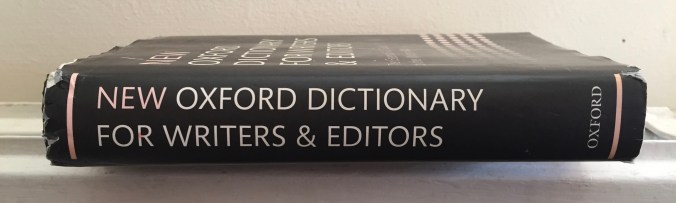
However, when it comes to working I do have to take account of all these things and apart from using The Concise Oxford Dictionary to check spellings, my absolute ‘bible’, and used by all publishers, is the New Oxford Dictionary for Writers & Editors. When I edit a book, I have to provide a Spellings & Style list of my references and spellings used; whether I’ve used -ed or -t endings etc. So I think my family and friends are going to have to continue to live with me being rather OTT about spelling!


David Michie: The Dalai Lama’s Cat

1D0AD718-9D15-41E0-AE6B-6565B4626F27

It may be some time since I wrote here about what books I’ve been reading but I can assure you the reading has been happening. It’s just a question of some being for work, some being for my book group (that has its own blog) and some I just didn’t feel inspired enough to write about and recommend.

The Dalai Lama’s Cat was irresistible to me. I first spied it on my daughter’s book shelves but decided to buy my own copy rather than borrow hers. I’m pleased I did because it’s a book that deserves more than one reading but also I’ve always had a weakness for wanting to have my own copy of books I enjoy a lot. I remember discussing this over lunch with another book editor once. We’d both bought books we’d borrowed from others and loved, just to have our own copies!

This book was irresistible because 1, it was about cats, and I’m a devoted cat lover (as my own cat Bella would attest to if asked, I’m quite certain), and 2, I’ve had a long interest in Buddhism and have also taught mindfulness meditation (part of some alternative health work I do).  The Dalai Lama’s Cat is categorised as a ‘novel’ by its publishers, but being Hay House, which was founded by the late and wonderful Louise Hay, then it was bound to have a spiritual element to it.

It really is a delightful book. It’s deceptively light in reading but full of wisdom and humour. There are wonderful, vivid descriptions of life within the Dalai Lama’s home, the Namgyal Monastery in Mcleod Ganj, India, and a host of colourful characters who are part of his – and later the kitten’s – life.  When the Dalai Lama notices a stray and injured kitten on the streets of New Dehli, he gets his driver to stop and the little kitten is carefully taken back to the monastery. Here, in a home filled with love and the privilege of being able to sleep at the bottom of the Dalai Lama’s bed and sit during the day in his office, HHC (His Holiness’s Cat, a.k.a Snow Lion) learns many of life’s lessons according to the Buddhist way of thinking. For anyone who wants to know more about Buddhist teachings this is a wonderfully accessible way to learn more and it’s a story told with love and happiness. I enjoyed it so much I’ve ordered the next 2 books in the trilogy: The Art of Purring and The Power of Meow. How could any cat lover resist!!

Ian McEwan: Nutshell

IMG_8596

Ian McEwan has been one of my favourite writers for many years; perhaps he is even my very favourite writer. I find his books both scintillatingly engaging right from the start, but sometimes so painful and often macabre that I can remember once, years and years ago – perhaps it was The Cement Garden? – I had to stop reading it on the train home from work and wait until later to finish it. Or maybe it was The Child in Time, recently made into an excellent TV film starring Benedict Cumberbatch? The story of every parent’s nightmare: taking your eyes from a small child for just one moment, to pay for something in a shop, and wham! The child is gone and your life will never be the same.

Nutshell also brings a lot of wham! bang! OMG! shocks. And it hooks you in from the very first two sentences: ‘So here I am, upside down in a woman. Arms patiently crossed, waiting, waiting and wondering who I’m in, what I’m in for.’ This is McEwan at his most inventive: a brilliant retelling of Hamlet but from the perspective of a ‘Hamlet’ in the womb, waiting to be born, all too aware of what’s going on outside. Gertrude becomes Trudy; Claudius is Claude. As the unborn Hamlet gradually realises that his mother and uncle are plotting to kill his father, we are witness to his dreadful dilemma: horror at what is planned and the child’s strong yearning to love their parent. And, of course, Hamlet is all about revenge, so how will this unborn child avenge the murder of his father? Well, I won’t spoil the ending, though of course we know how the story plays out, but this time in McEwan’s unique and chilling way. I found this a totally compelling, clever, suspenseful read but full too of wonderful humour that made me actually laugh. Highly recommended.


Manuscript to Book: A Short Guide to the Book Publishing Process

A lot of my freelance book publishing work is copy-editing and proofreading. People often ask me what the difference is and so I thought it might be useful to guide you through the basic steps of a book journeying from manuscript to a published book. Of course, nowadays, your ‘manuscript’ will most likely be a ‘typescript’ – not many authors write by hand still! And mostly it’s typed on a computer and so you may automatically think of sending it as an email attachment to a potential publisher or agent. But it’s always wise to check out the requirements of different publishers and some will want an actual paper submission sent through the post. I’m going to write more about ‘submissions’ another time but for now, I’ll outline the basic steps.

Manuscript (or Typescript)

You’ve finished your work and it’s all ready for you to now find a publisher. It’s often easier to find an agent to act for you, but more of how to submit your work another time. So let’s move on to the point when your book is accepted by a publisher. This basic copy forms of the foundation of what will become a book. First of all, it will be read by the editor who commissioned or bought it. ‘Commission’ means they approached you to write it; ‘bought’ means it was sent to them by you direct or an agent.

Structural Editing

It’s most often – though not always – the commissioning editor who will read the manuscript first to decide whether any major changes or improvements are needed. ‘Structural’ is just what it says: does the structure of your book, the storyline, or maybe in a non-fiction book the way the information is put together, work well. The editor will identify things like a particular character needing more or less work – an important character who perhaps needs more depth and to be more strongly described; but perhaps you’ve given too much time to a minor character who then detracts from the main storyline and characters. An editor will perhaps get you to expand certain parts of the story but maybe suggests cuts for parts that are too long and affect the flow of the story, losing the reader’s attention. Once all the book is in good shape and you and the editor are happy, it will be passed to a copy-editor.

Copy-Editing

The copy-editor is concerned with correct and consistent spellings and good grammar. They will also look at the flow of the book, whether it reads well and may make basic rewriting suggestions – perhaps switching the order of words, adding or taking away odd words or sentences, expanding or rewriting something that isn’t clear or makes easy sense. They will check for consistency, and this includes things like keeping a track of time: e.g. if a character is, say, 20 at the beginning of the book and the story moves on 10 years, their age should be given as 30. Likewise relationships between characters: that an ‘uncle’ is always an uncle and not sometimes a ‘great uncle’. The copy-editor will check for repetition – whether you’ve already said something or described or explained something. They make sure any ‘facts’ are correct – historical dates, spellings of real people or places.

Once books were copy-edited by hand: paper copy with the changes marked in pencil. But now I always copy-edit on-screen – the book is sent by email and I edit it with track changes and comments for my queries, and it’s returned by email. At the end of the copy-editing process, the book should be in good order to go to the printer. The author (and commissioning editor) will get the chance to check through any changes though and answer any queries the copy-editor has had before the book goes for printing.

Design

The copy-edited book will now go to the Production Department for design. This can be a fairly simple process for perhaps a novel – what font and font size to be used; the general layout of the page, whether a new chapter always begins on the right-hand page, and ultimately the cover design. For a more complex or non-fiction title, the design will require a lot more creative thought.

Typesetting and Printing

The next step is to typeset the book – arrange the words on the pages; decide on the layout of special things like quotes of verse, letters or other text that is often indented or in italics. The book needs to be ‘set’ in just the way it will appear in the finished book. This is sometimes done at the printers or by a separate typesetter. Once the book is typeset then the printer will print off ‘page proofs’ or email them to the publisher.

Proofreading

I still receive proofs as paper copy, i.e. printed out on paper. Occasionally a quick job or short job, particularly on an e-book (one to only be published that way) may come via email and I proofread on-screen, but by far the majority of my proofreading work comes via the post as a large parcel of paper! I then proofread it with a red pen, blue pen and pencil to hand. Red pen is to mark printer’s errors – things that haven’t been printed exactly as they are on the copy-edited typescript (I will always have a copy of that to check against); blue pen marks errors missed by the copy-editor (there are invariably a few, though rarely many); pencil is for any queries I might have – sense, an unusual word  or spelling. Once I’ve finished, I will parcel it up and return to the publisher. Usually the author will receive a set of proofs too so they can check as well; an important or ‘big’ commercial title by a bestselling author may be proofread by more than one professional.

The Finished Book

The next thing of course is for the printer to print the book – print the pages and bind the book, either as a hardback or paperback. But publication isn’t just about the arrival of finished books at the publishers, it’s about marketing and PR, it’s about distribution to bookshops, etc. And often now an author will be expected (and want) to be involved in the PR with book signings, talks, etc.

This is a basic guide but hopefully helpful to you. Do let me know if you have any questions!