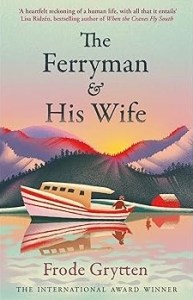
The Ferryman & His Wife by Frode Grytten

When I bought this book last week in my local Waterstones, the sales assistant told me how much she’d loved reading it and it would make me cry. Well yes, there is sadness here, but it’s also wonderfully life affirming. The novel is a kind of meditation on life, told by ferryman Nils Vik as he sets sail for the last time in his boat across the Norwegian fjord that has been his home for his whole life. He knows this will be his last day on earth and he meets all the people who have been important to him: passengers, family, friends and, most important of all, his wife Marta.

Over the fjord he goes … This is how his last day begins. Standing at the wheel , listening to the past ... ‘ He wonders, ‘Is that the dead coming through the openings of the forest? Yes, here they come.’

When the book opens we see Nils tidying his house, throwing things away, leaving it ready for his daughters when he’s gone. He even burns his mattress: ‘The mattress told the story of his entire life. It felt too private to allow other people … to deal with their past.’

On his journey, Nils is accompanied by the ghost (although the word ‘ghost’ is never used) of his old, faithful dog, Luna, who talks to him. Nils picks up dead people on his way, people who have made an impact on his life in some way: passengers going to work, going to church; doctors and midwives; teachers; young lovers; unhappy kids. He also meets his troubled younger brother, and he remembers his daughters (still alive). His boat provides a ‘little waiting room in time for people‘ who open themselves to him. He provides a calm and compassionate presence to others and the author has created this character so well, we too, as readers, are drawn to him: a man both very ordinary and very special.

We see both Nils’ joys and his challenges as he revisits his journey through life. And what of Marta? The ‘wife’ in the title? This is a relationship which gives him both joy and challenge.

This is a wonderful read. The writing is beautiful, lyrical, and the story is a profound telling of life itself, its ups and downs; the ordinariness of life and its uniqueness in every living soul.


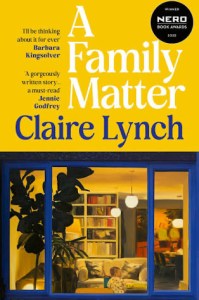
A Family Matter by Claire Lynch

I was filling in time before meeting a friend for an early supper  at The Palomar. When I’m in the Piccadilly area I always like to allow time to go into Waterstones. Housed in an Art Deco building, it’s the largest bookshop in Europe. It has a fantastic travel section in the basement, where you’ll also find a good cafe. But stepping into the ground floor from Piccadilly, it’s easy to get caught up in browsing the shelves and tables packed with enticing books. I was attracted to A Family Matter by the blurb on the back and seeing that it was shortlisted for the Nero Book Awards in 2025. It’s also quite a short book, almost a novella. It’s not that I’m averse to reading long books, but when I’m busy with my book publishing work, I like to have a short book to delve into for a quick fix of a good read. My work generally provides lots of good reads, but reading something I’ve picked up in a bookstore, chosen and paid for is a different kind of delight.

I’m always intrigued by family set-ups, how they work, different relationships. A Family Matter moves between two times: 1982 and 2022. It opens in the later time and Heron (really Henry but always known as Heron) finds out he has cancer and a limited time to live. He contemplates not only the reality of knowing he will soon meet death, but how his life will now be otherwise changed, and how it will be when he tells his daughter, Maggie. They talk on the phone daily, though Maggie is now a 43-year-old mother of two (Tom, 14, and Olivia, 8) and married to Conor, but for a long time it was just the two of them and the bond holds.

Then the narrative moves back 40 years to Dawn, Maggie’s mother. When Dawn meets Hazel, suddenly her dull and predictable life is filled with exciting possibilities … but there’s no way she can envisage just how this new friendship, this new love, will change her life so dramatically, and the price she’ll have to pay for straying from the ‘norm’ and ‘accepted’ of the 1980s.

Maggie can barely remember her mother. She was only three when Dawn went out of her life; a loss that was never explained to her; a loss that she’s never been able to discuss with her father. But when Heron starts sorting though years of papers and documents, trying to tidy his life before it’s too late, and Maggie helps him, she comes across papers that completely upend the life she’s known. She’s never been able to accept that her mother abandoned her, it’s affected her own mothering, how she is with her kids, how she tries to be everything she wishes she’d had from a mother. And now … now she sees how she’s been deceived and she and her father must negotiate a new path in their relationship before he dies.

Back in the 1980s it was almost impossible for a lesbian mother to gain custody of her child when a marriage to the child’s father ended. Claire Lynch details the law at the time in an Author’s Note at the end of the book and the details of how the mothers were viewed is shocking. There’s a lot to be shocked by in A Family Matter. There is grief, but love too. There is misunderstanding and there is confusion. Both Heron and Conor tell Maggie, they were different times. And indeed they were. But to what extent does this excuse Heron’s behaviour or indeed, Dawn’s – had she tried hard enough to keep contact with Maggie. It’s a complex story of strong emotions but it’s also beautifully written and I found myself completely caught up and could barely put the book down till I’d finished (so perhaps it was a good job it’s quite short!).


The Two Roberts by Damian Barr

I’ve been having a holiday from work over the Christmas period and enjoying having the time to read books of choice – books I’ve bought rather than ones I’m paid to edit. One of them is The Two Roberts by Damian Barr. I’d read a good review of it and was particularly attracted by the art connection: the book is about two artists who lived in the first half of the 20th century. The novel is based on the true lives of the artists Robert (Bobby) MacBryde and Robert Colquhoun and gives an insight not only into the art world of the time – many artists appear: Lucien Freud; Francis Bacon; John Milton (who illustrated Elizabeth David’s A Book of Mediterranean Food) – but the dangers of being gay at that time. With its beautiful, lyrical writing, it is also an ode to love: to love at first sight when Bobby first catches sight of Robert on a train; the enduring love that weathers the kind of wild life many artists lived at the time; separation during World War Two; artistic jealousy because Robert’s work is constantly judged better than Bobby’s. But above all, the love that survives the challenges and dangers of being gay at a time when it was illegal; a love that sees them rejected by their families and constantly in fear of discovery.

From early on their teacher at the prestigious Glasgow School of Art – from which they graduate as top students of their year – sees the two produce better work when they work together and for their whole lives they will be seen as a unit. But there’s pressure in this too, their professional and personal lives so intimately and strongly entwined: they cannot live without each other but they cannot always live in peace with each other and their fights and arguments become famous amongst those who know them.

I was immediately drawn in by the poetic writing: the opening when the two lovers are ‘curled like commas’; their tutor when they first meet him rubbing ‘his hands over an invisible fire’, which so vividly creates the image of how he looked. From their home towns in Scotland, the story follows them to London, Paris and Rome. They are celebrated as great artists but the cost is devastatingly high.

When the author Damian Barr came across the two Roberts’ story, he wanted to give them the recognition he felt they deserved, and in doing so has written a compelling, rich and absorbing novel. Apart from the story of the two men, the book provides a vivid social insight to the times, from the poor homes of small town Scotland to the hedonistic lives led in London’s Soho.

You Are Here by David Nicholls

I didn’t get on with Nicholls’ early books so have given him a miss in recent years. However, I was browsing Waitrose’s books – yes, Waitrose! My local branch has a small selection of books which are usually sold at a discounted price, £6.99 instead of £9.99 – and picked up You Are Here and thought, I really must give David Nicholls another go. I’m so glad I did for this was one of the best reads I’ve had in a while.

It is, essentially, a love story, which unfolds over the course of a few days’ coast-to-coast walk across the north of England from Cumbria in the West to North Yorkshire in the East. It’s organised by Cleo who brings together a small group of friends, including Marnie and Michael. Both are reeling from the aftermath of divorce (Marnie, aged 38) and separation (Michael, aged 42). Cleo is hellbent of matchmaking but she doesn’t imagine Marnie and Michael with each other – she has other people in mind for them.

Both Marnie and Michael have fallen into leading solitary lives. Friends have married, had children (they couldn’t in their marriages) and drifted away. Michael we learn, had an ‘accident’ – or was it a ‘fight’? – before his wife left him, which has left him both mentally and physically scarred. It’s not until near the end of the book that we learn the details. Marnie buries herself in her work as a freelance copy editor. As a freelance editor myself, I was slightly taken aback by how she almost never stopped working, even in pubs and on trains, and this was surely not just for the money she needed, but an escape from her solitude. But at the end of the first chapter we are told, ‘Sometimes, she thought, it’s easier to remain lonely than present the lonely person to the world … It was no good. She would have to go outside.’

Cleo’s matchmaking is so OTT that frankly it makes her come across as a bit of a bully and not particularly likeable. But this controlling need in her leads her to organise an ambitious and quite demanding walk for her friends and she also books their accommodation en route. Almost the entire book follows the walk and Michael and Marnie’s stories are told in alternate – quite short – chapters.

Michael is a keen walker. He’s a geography teacher and thus understands much about the terrain and its history and the teacher in him can’t always resist educating those around him. Normally he prefers to walk alone and in many ways it’s an escape from moving on in his life. Now, with Cleo’s friends in tow, he feels some responsibility as they are all novices and his instincts for solitude fight against trying to be part of a group.

Parts of the walk are quite brutal and gradually there’s only Michael and Marnie left. They annoy each other at first, they are so different in many ways, but inevitably (this is a love story, after all) something slowly stirs between them. But can it really work? Not only do they have to overcome their differences, but finally let go of their past relationships.

It’s a wonderful read both for the vivid descriptions of the stages of the walks – the villages and landscapes they pass through and (usually rather horrendous) places they stay at night – with the odd input of humour (mainly from Marnie). Nicholls has a deep understanding of his characters’ psyche, shows much empathy for them, and he’s appealingly philosophical about life. Thus the book is really much more than a love story, it’s about life itself, second chances, and is delightfully hopeful.

Gabriel’s Moon by William Boyd

This was a bit of a spontaneous buy. I was wandering around my local Waterstones looking for a book to fill a gap between work. Sometimes when I’m deep in a book editing job and have to hold a lot in my head as well as make notes, I find it too distracting to get deeply into a book I’ve bought as well, so little gaps in work are a welcome chance to buy a book of choice.

I was a great fan of Boyd’s early work – An Ice-Cream War, Brazzaville Beach, etc. – but haven’t taken to later books quite so well. However, here before me was a paperback of his latest book, Gabriel’s Moon, the cover full of enthusiastic reviews praising his storytelling, with an intriguing sounding ‘tale of globe-trotting adventure (Guardian)’ so I decided to give it a go.

Gabriel and I got off to a good start, the title of the book soon being explained as 6-year-old Gabriel’s night light – a glass moon globe – features in the opening paragraphs … and then is blamed for a terrible house fire that completely destroys his home, kills his mother (his father is already dead) and leaves him an orphan. We quickly jump 24 years. Gabriel is starting to make a name for himself as a travel writer; he has a cordial but fairly shallow relationship with his older brother Sefton, a civil servant; he lives alone and has a girlfriend who is fun with whom he has great sex, but she’s not someone he wants to be with for ever. Gabriel clearly has commitment problems. He suffers from severe insomnia which leads him to seek help from a psychoanalyst. With his regular nightmares of fires, it seems the house fire of his childhood must have more significance than he’s aware of and he thinks if he’s able to remember more of the night and what happened – memories he’s obviously shut down – he may be able to solve his sleep problem.

Soon though, we see him manipulated into a world of espionage. This is 1960 .. the time of the Cold War … the nuclear threat in Cuba. When Gabriel makes a trip to the newly independent Republic of Congo, his travel writing takes a political turn when he’s unexpectedly given the chance to interview the new president, who is murdered quite soon after. The interview leads him into a dark and dangerous world; a world of duplicity and deception. Suddenly it’s hard to know who he can trust: is his brother really a straightforward civil servant or a spy? Are the editors and agents who find him work more than they seem? What of the psychoanalyst who confesses she doesn’t actually have any qualifications, though seems to help him? And what of his MI6 handler, Faith, who clearly can’t be trusted to tell him the truth but who he becomes more and more obsessed with and attracted to.

The novel becomes increasingly complex as Gabriel travels around the world, trying to write a new travel book while at the same time fulfilling jobs for Faith that are ever more dangerous. New people are introduced and he’s drawn more deeply into the world of spies and no one is quite what they seem. For me, there is clever complexity in the world of books and tedious complexity. Gabriel seemed increasingly to be drawn into the world of spies through naivety rather than chance or purpose. He wasn’t really a character I could admire. We don’t always have to like characters but we need to admire the ones around whom a story is based; even if they are not good people, are evil people even, there has to be some kind of strength in them that makes reading the story worthwhile; for it to make sense. Gabriel’s Moon made less and less sense as it went on. Too many intriguing possibilities were introduced but never resolved. Even the Moon: I kept feeling that there must be some kind of link to the spy story and it seemed not. Though perhaps the fire experience made Gabriel into the man who was vulnerable enough to be manipulated so badly.

Most of the reviews of this book are full of praise, though I did find the odd one more in line with my own thoughts. Some suggested that the unsatisfactory ending left things open for a sequel – but leaving books open for a sequel isn’t supposed to happen like that. You’re supposed to think the ending, the book, is so brilliant you want more. I like reading thrillers; I like reading crime novels … maybe I’m not a spy book person. But this novel left me not just cold, but hugely frustrated by its rather scattered storyline, unsatisfactory ending and unattractive characters.