Long Island by Colm Toibin

So much did I enjoy Colm Tóibín’s Brooklyn (2009) that I took the rare step of pre-ordering the hardback of its sequel, slightly discounted from Amazon, to arrive on its publication day last week. 

I remember being disappointed by the film Broolyn‘s ending, feeling it wasn’t quite faithful to the book. Once I started reading its sequel, I thought I should have reread it as, fifteen years on, my memory of exactly what happened and how it ended was a little vague. However, I remembered enough and was soon caught up in Eilis Fiorello’s (née Lacey) story once again.

Twenty years on from Brooklyn (and now the 1970s), Eilis is living with her husband Tony and their two teenage children, Larry and Rosella in Long Island. It’s no spoiler to tell you that right at the beginning of the story, a man appears on Eilis’s doorstep to tell her that his wife is expecting Tony’s child and there is no way he will allow it to live in his house, so he will bring it to her. Tony is a plumber and has been having an affair with one of his clients.

How Eilis handles and processes this devastating shock, is the focus of the book. We see a more confident, independent Eilis than in Brooklyn, but a woman suffocated by her husband’s Italian family who all live close together and treat her as an outsider, despite her really being no more of an outsider in New York than them. It’s 20 years since she left Ireland and she considers herself American.

Eilis doesn’t confront Tony immediately and there is a kind of uncomfortable ‘dance’ between them as their life goes on ‘as normal’, and even when Tony knows Eilis has been told what’s happened, they don’t really talk about it in any depth. All Eilis says is that she will not have the baby in the house and she doesn’t want her mother-in-law – who lives opposite – to take the baby in (Francesca has said she will). Eilis says and asks surprisingly little, and never seems to question whether she’ll stay with Tony. I found it a little frustrating.

Finally, she decides to go back to Ireland, her hometown of Enniscorthy, for a while, both for distance to think and decide what she wants to do, and to join in the celebrations of her mother’s 80th birthday. It’s the first time she’s returned in 20 years and her children will join her a couple of weeks later, meeting their Irish grandmother and family for the first time.

Eilis’s mother gives her a spiky reception. She’s never acknowledged the photos Eilis has sent over the years of her children; she criticises her Americanisms. Nancy, Eilis’s former best friend has mixed feelings. She’s pleased Eilis will be home for the wedding of one of her daughters, but wary as she’s secretly having an affair with Jim Farrell, who runs the local pub, and they plan to announce their engagement after her daughter’s wedding.

Famously in the town, when Eilis returned home twenty years before, she and Jim had an affair that everyone expected to end in marriage. What no one knew was that Eilis was already married to Tony. When she returned to New York, she left Jim not knowing why she’d suddenly left, although he soon learned through gossip that she was already married. He has not forgotten her and he’s never married. But he’s lonely, and Nancy – a widow – promises to rescue him from the loneliness of middle age. 

Eilis’s return to Enniscorthy brings inevitable confusions and jealousies and uncertainties. How will it all play out? Eilis and Jim discover they still love each other but will Eilis stay or return to New York? She has not only herself to think of, but her children. And what of Nancy who is secretly planning her wedding to Jim, who says nothing to halt her when he starts secretly meeting up with Eilis?

I was quickly caught up in Tóibín’s writing again: his stylish prose that reads so beautifully; his apparently easy understanding of relationships and how people think. Yet, as the novel went on, I became a little frustrated. I had to remind myself it is set in the 1970s when leaving a husband and children, divorcing, even when the husband has made another woman pregnant, was not so common or easy. 

I felt there was a weakness in the characters, not just Tony who is a rather pathetic man, but Eilis and Jim seemingly unwilling to commit to a decision. And the end was amazingly abrupt and frustrating. It’s clear there will be a part three to this series and I guess I will want to read it, but I have to say that Long Island was in the end a bit of a disappointing sequel for me – although it’s been collecting many wonderful reviews, describing it as a masterpiece.
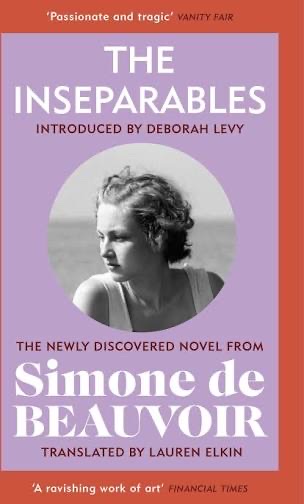
The Inseparables by Simone de Beauvoir

7AEDBEDF-E77E-42E2-ADD4-FA7F4C05588C_4_5005_c

My daughter Nicola bought me a couple of books for Christmas, one of which was a novella by Simone de Beauvoir (1908-1986), The Inseparables. Described as a ‘newly discovered novel’ from the great French writer and written in 1954, it inevitably makes one wonder if a book that has remained unpublished for so long is any good. Well, I’m pleased to tell you that it’s a book I found wonderful: moving, passionate, tragic and beautifully written, having been well translated by Lauren Elkin. It was published in 2021.

The Inseparables is based on a real life friendship that de Beauvoir had as a child, from the age of nine, with a girl in her school class, Elisabeth Lacoin, known as Zaza. In the book Simone becomes ‘Sylvie’ while Zaza is ‘Andrée’. My instinct as I began reading was to immediately think of Elena Ferrante’s novel My Brilliant Friend that also follows the close friendship of two girls. I’ve never got on with Ferrante’s novels; she seems to be, as we say in UK, a ‘Marmite’ person – you love her or hate her. Maybe ‘hate’ is a bit strong but I’ve never enjoyed her writing. Happily, this first connection made in my head was soon dispelled and I was almost immediately drawn into this intimate portrait of a friendship and de Beauvoir’s glorious writing. It’s one of those books where there are such beautifully crafted sentences, you want to sometimes stop and savour them.

Sylvie comes from a bourgeois family whose circumstances become very challenged when her father loses his job as a result of the fallout from the First World War. Andrée’s family, however, is very well off. These financial differences are almost outside the girls’ friendship but what they signify is what each can expect in life and from their families. Andrée, who has recently recovered from a terrible accident, is intellectually very bright and amusing but the prospect of using her intelligence is limited by her family’s expectations that she will either make a suitable marriage or enter a convent. Sylvie, however, also very clever, looks to finding a career and earning a living. A big bond between the girls is their conversations: ‘We could lose ourselves for hours in discussions of property, justice and equality.’ But Sylvie also feels inferior in some way; boring in comparison. Her feeling for Andrée is a kind of love; at one stage she says she couldn’t live without her. The feeling isn’t so much sexual but a more a kind of awe that she doesn’t expect to be reciprocated in the same way.

At the beginning, both girls are religious but then Sylvie loses her faith. During a confession she suddenly realises: ‘I don’t believe in God!’ And rather than any feelings of guilt, Sylvie becomes rebellious but also begins to recognise how Andrée’s deep faith is a form of torture to her and limits her being true to herself.

At the beginning, Sylvie was jealous of Andrée’s close relationship with her mother – who doesn’t approve of Sylvie. But as the girls grow older, she sees that her mother’s control and demands are suffocating Andrée. Andrée starts to do dangerous, even self-destructive, things to avoid family situations she doesn’t want to take part in. One time she stabs her foot with an axe so she can’t go to stay with a family she dislikes. As more ‘social duties’ are imposed on her friend, Sylvie worries more and more about her troubled mental state: ‘She did not belong to herself. She had no private time … She was stifled.’

The girls eventually go to the Sorbonne to study. Here love enters Andrée’s life. There had been a fairly innocent love with a cousin early on, and then a friend of Sylvie’s at the Sorbonne, Pascal, with whom Andrée falls deeply in love. The interference and demands of Andrée’s family, particularly her mother’s, lead to tragedy. And it is apparently this tragedy that leads de Beauvoir to carry guilt throughout her life, partly answering the question of why this novella wasn’t published earlier.

It is a very short book with interesting and enlightening introductions by novelist Deborah Levy, the translator Lauren Elkin and an Afterword by de Beauvoir’s adopted daughter, Sylvie Le Bon de Beauvoir.

The Thursday Murder Club by Richard Osman

E631FA8A-44EB-4A45-A864-DCF216F7A2FB_4_5005_c

I’ve been going through a phase of reading crime novels. Like many phases that come and go, it’s one I inhabited many years ago when I was hooked on the novels of PD James and Robert Goddard’s thrillers, but in recent years I’ve mainly only read crime as part of my work as a freelance book editor, apart from a few of Donna Leon’s books, chosen primarily for the Venice setting. However, after reading Leon’s latest recently and the Tom Benjamin I reviewed here (click here), I pondered over Richard Osman’s offerings as I considered more crime reading. I wasn’t sure. A crime novel set in a retirement village in Kent didn’t hold quite the same attraction as those in Venice and Bologna. Even the cover speaks of something a little cosy, slightly old-fashioned and perhaps not quite my thing?

Still, I do like Richard Osman. Or at least I like him as much as we can like anyone we ‘know’ only via TV and the media. And he studied Politics & Sociology at Cambridge so he did seem like a celebrity who could probably write well without the need of a ghost-writer. I decided it would even be a good bit of research for my work; that I ought to know what Richard Osman’s books are like, given his name and his books’ success.

The Thursday Murder Club, published in 2020, is the first of three books in the series to date, so it seemed the best place to start. 

The setting is the fairly exclusive retirement village of Coopers Chase in Kent and the Thursday Murder Club comprises a group of friends who meet every Thursday to investigate unsolved murders. The club was begun by Penny, a former policewoman who feels she missed out on the best action because she was a woman and that she wasn’t promoted to the level she deserved. Now was her chance to solve some difficult murders. By the time our story begins in the novel, however, Penny is lying in a vegetative state in the hospice part of the village. Nevertheless the club continues with the four remaining friends: the formidable Elizabeth, who is clearly in charge and we soon realise was once a spy; Joyce was a nurse, only able to live in the village because her lawyer daughter funds it; Ibrahim, is a retired psychiatrist; and Ron a bolshie former trade unionist who is pretty much channelling Arthur Scargill much of the time. They seem an unlikely bunch of friends – all in their 70s and 80s – but an interest in murder and a desire use their brains and keep sharp, lead to them forming a close bond.

The light, almost game-like nature of their Thursday investigations takes a dramatic turn when a real murder lands on their doorstep; or more literally at the gate of the village’s cemetery. A murder that took place during the day, with lots of people around, yet no obvious perpetrator. The victim is the unpleasant and greedy owner of Coopers Chase, Ian Ventham, who plans to bulldoze through the cemetery to build more homes. Many of the inhabitants of the village are angry and form a blockade so workmen can’t get in. But despite all the anger with and dislike of Ventham, who would go as far as to kill him and why? The method of killing is soon known: an injection during a brawl with a lethal poison. But one that would need someone with medical knowledge to inject in just the right place. So that narrows things down … but far from solves the mystery.

As the story develops, many more characters appear, each with their own stories, many with reasons to want Ventham dead and long ago crimes of murder and drugs are uncovered, not to mention love, revenge and gang warfare. But strangest of all, just before Ventham was murdered, a man working for him started digging up one of the graves and discovered a skeleton on top of the buried coffin … an extra and newer skeleton. Another murder?

The book has often been described as a ‘cosy crime novel’ and that seems a good description in many ways. Osman uses a nice conversational style and creates a cast of likeable, if occasionally mysterious, characters but, to be honest, despite the early murder it was all quite tame at the start. Was it going to be a disappointment. I felt the older people were presented in a rather clichéd way: uncertain of modern technology, struggling with texts, constantly drinking, even sherry; not altogether keeping up with the times. I’m not as old as the people in this book but old enough to get a bit prickly about how older people are presented.

I’m glad I kept going though (I do give up on disappointments sometimes). The storyline line gets more complex; the range of characters with such different backgrounds and stories is engaging; and the four main characters become rounder and more interesting as we get to know them more. Osman tells us of some of their and other characters’ tragedies with great sensitivity: Elizabeth’s coping with her much loved husband’s dementia; Joyce’s longing to win her daughter’s approval; and there’s a story of tragic young love and brutal gang relationships. There’s even a quick trip to Cyprus. 

Many have described the book as ‘very’ funny; I’d say Osman displays a nice, gentle wit that is pleasingly amusing. I did feel as it went on with its many twists that some of them felt a little contrived; I might even say it all became a little too complex with seemingly endless revelations in the last sprint to the end. But more importantly, I became more and more attached to the story and characters; I became quite hooked, even, and was very glad I’d read it.

Osman has been quoted as saying he doesn’t like the ‘cosy’ description, but, sorry, Richard, I do feel that it’s fair. And really, you might say Miss Marple was ‘cosy’ too in her way. I think what’s meant is that it’s very British. It’s set in contemporary time but it could just as easily be a few decades ago – though I’m not sure when exclusive retirement villages arrived and of course there wouldn’t have been the mobile phones.   

The book is being turned into a film, which I imagine is going to be very entertaining.


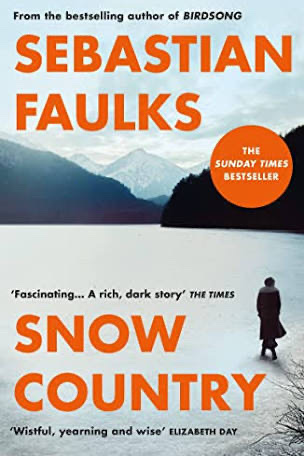
Snow Country by Sebastian Faulks

E0B58132-EC52-4B40-899A-A1AACC4A96C0_4_5005_c

I loved Sebastian Faulks’ early works: The Girl at the Lion D’or (1989), Birdsong, (1993) Charlotte Gray (1998) and On Green Dolphin Street (2001). Birdsong is one of the few books I’ve reread and after reading this latest book from Faulks, Snow Country, I feel I should go back to Birdsong and reassess it in a 21st century, 30 years later light. Would I still rate is as one of my favourite books ever?

I’ve been less taken by Faulks’ later books; some have been okay and some I’ve given given up on (as a book editor who has to sometimes carry on reading books I don’t like, word by careful word, I don’t ever feel I have to struggle on with a book I’ve chosen and bought but am not enjoying). Despite the fading of my enthusiasm for Faulks, I still can’t resist a new book of his and carry the hope it may transport me once again to the delights and power of his early novels.

Snow Country takes us into familiar Faulks’ territory around the time of the First World War and moves towards the Second and is mainly set in Austria. It is the second in a proposed trilogy, the first being Human Traces, which was published in 2005 (so quite a long gap until the 2nd!). Faulks notes at the beginning though that the book stands on its own.

The book opens dramatically with a detailed description of a surgeon operating on a man in the war zone. When the operation is completed and the surgeon is sewing up the wound, a nurse asks, ‘Is he going to survive?’ ‘Of course he is. Poor soul,’ answers the surgeon. The wounded man is the protagonist of the book, Anton, and the surgeon’s answer, ‘Poor soul’, is less about physical scars that Anton will carry and more a signal of what lies at the heart of the book – the question of what makes a good life; a life worth living.

Faulks has always been good at examining the internal lives of his characters, which is a large part of his books’ appeal to me. It was interesting to note in the short biography at the beginning of Snow Country that Faulks was given an honorary doctorate by the Tavistock Clinic for his contribution to the understanding of psychiatry in 2007 and that he has spoken at psychiatry conferences in London and Venice. Psychiatry is not his background, he read English at Cambridge. However, his interest in psychiatry forms a base for this novel (and also its preceding Human Traces), as much of the story takes place in a sanatorium for the mentally ill, Schloss Seelick, and in Vienna at the time of Freud.

The young Anton rejects going into his family’s sausage business and instead he becomes a journalist, hoping this will enable him to travel the world. In Vienna he meets Delphine, a French pianist and slightly older than him. He falls madly in love, but then, finding himself working in Paris as war breaks out, when he eventually manages to return to Vienna, Delphine has disappeared without trace. He feels guilty he put work before her and didn’t return earlier. They are now enemies, of course, but he would have urged her to return to France. The guilt adds to his devastation at the loss of the love of his life. And it is a loss that he spends the whole book trying to reconcile and affects not just his view of love, but life itself, its meaning and purpose.

Lena is the sixth child of an alcoholic prostitute in a small Austrian town. Surprisingly, her mother decides to keep her rather than send her to an orphanage, as she did with her other children. Hungry for love, even the kind of love she might expect but doesn’t receive from her mother, Lena is determined to control her own life. She moves to Vienna where she meets the idealistic young lawyer, Rudolph, who takes her on as a kind of cause, wanting to help her. But the relationship is confusing, Lena thinks eventually he loves her but can’t say it, and thus she instigates sex one evening thinking this is what he wants. It goes horribly wrong and Rudolph recoils from the physical contact. Lena at first throws herself into drinking and prostitution but then leaves Vienna and goes to work in Schloss Seelick where she hopes to leave her past behind her.

Meanwhile, Anton is enjoying increasing success as a writer and is commissioned to visit Schloss Seelick to look at its methods and investigate an earlier scandal. Attracted by the quiet calm of Martha, who has taken over the running of the clinic from her father, and her modern methods of psychoanalysis, he decides to undergo ‘the talking cure’ himself, to try to at last process the lingering melancholy at losing Delphine and never finding out what happened to her.

There are a lot of long conversations about psychoanalysis, Freud, etc. I found it fascinating yet it is also quite heavy going. We are witnessing the lives of Anton, Lena, Rudolph and Martha and while they are all intertwined to some degree, the threads never really seem to come into a cohesive whole. In the background is the love story of Delphine, yet after so many years – twenty years later – is it still a love story or more an indication of Anton’s troubled mind? And Lena, who recognises Anton as a man who visited her for sex in Vienna and is terrified her secret will be revealed and she’ll be thrown out of Schloss Seelick, is her attraction to Anton love as she comes to believe or something else? And what of the confused Rudolph who comes to the Schloss too, in an official capacity as a lawyer but also seeking out Lena? And Martha, who hides surprising secrets of her own, and her views of modern psychiatry?

There’s quite a lot of confusion in the lives and relationships of the characters, yet that’s the very meat of psychoanalysis. We are asked to consider past lives and future lives; what being alive means; and in the end whether life itself is just a joke: ‘There was no love that lasted, no life afterwards …’

I was definitely hooked on this novel and read it almost straight through, yet it wasn’t a totally satisfactory read. It’s described by some critics as a love story, yet for me it’s not really that. Yes there is love and an examination of what love is, but there’s no burning love story; even the Delphine story is coloured by all that goes with it and it feels more like something Anton refuses to let go of rather than a true deep love. The book is also in part a war story, with the loss of loved ones and the nature of the politics at the time. But the love, the characters, the events, are all a bit disjointed; the final story of love doesn’t quite hold true. For me, the book is mostly about life itself, its purpose and meaning, and the nature of love. And, if it’s not a perfect book, it does throw up some interesting ideas to think over.

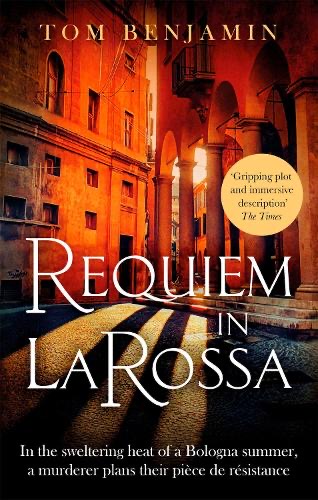
Requiem in La Rossa by Tom Benjamin

41BD7445-1EFF-430A-8410-A226AA6CECEA_4_5005_c

I saw ads for this book a few times and in the end couldn’t resist buying it. I enjoy a good crime novel occasionally, but it was the setting in La Rossa – Bologna – that caught my attention. When I went to Bologna back in 2014, I fell in love with the city – not just for its famous food but its beauty and atmosphere. This book seemed a good way to revisit it, albeit it in a rather more grisly way than anything I encountered while actually there!

Requiem in La Rossa is Tom Benjamin’s third novel (the first two are now ordered!). Benjamin grew up in north London, worked first as a journalist and then became a spokesman for Scotland Yard before moving to Public Health where he led campaigns against alcoholic abuse and a drugs awareness programme. Thus he has all the right credentials for much at the heart of this novel. But equally crucially, he actually lives in Bologna and knows every alley, cafe and park and gives us a glorious immersive experience of this beautiful city.

Bologna’s university is the oldest in the world, founded in 1088. The novel explores Bologna’s cultural life, focusing on particularly the music and educational history with a wonderful splash of art, as English private detective, Daniel Leicester, describes the work of his artist girlfriend, Stella. There’s a great section where he explores the art installation Stella has set up in the university: ‘Stella had created paths between an Aladdin’s cave of junk in her first Room – piles of plates, boxes of cutlery … Across the walls, those old paintings she had discovered: tower blocks drove into orange skies … the very fabric of existence was about to shatter against the insistent strain of the future.’ Clearly, Benjamin would be the ideal person to have with you next time you find yourself puzzling over installations in an art gallery.

But of course this is essentially a crime novel and thus we must expect violence and intrigue – all the tension heightened by the backdrop of a sweltering hot Bologna in summer and a series of earthquakes that set the city shaking and rumbling, almost in response to the crimes stalking its most revered quarters. We encounter brutal murders, puzzling poisonings, jealousies and bribery. Even the life of our ‘hero’, Dan, is threatened and perhaps more alarmingly, that of his 15-year-old daughter Rose.

When a professor of music drops dead leaving an opera, after being apparently threatened by an old student, Guido Delfillo, now a drug addict, Daniel – part of a family firm of private eyes; his late wife’s family – is hired by rock star Vesuvio to clear the young man’s name. Delfillo, once an exceptionally talented young musician, was rejected by the university, despite his huge talent, which led to his downfall, and then by Vesuvio. Vesuvio now feels guilty and wants to help him. It looks as if the professor was poisoned but it seems impossible for Daniel to prove this as none of the usual poisons can be found during the post-mortem. Meanwhile, another student, who was around at the time of the death and seemed to be putting something in the professor’s drink – caught on cctv – is found hanged. Suicide or murder?

Daniel has also been hired to follow an adulterous wife – the kind of stuff we imagine private eyes spend most of their time doing – and while there seems no link at first to the professor’s death, one dramatically and violently appears.

The story is very complex, with lots of twists and turns that keep you constantly questioning and guessing. Daniel frequently finds himself at odds with the local police in his quest to get to the truth and at one point, even his father-in-law, also part of the business, questions whether he’s taking things too far. But we are also drawn deeply into Daniel’s personal story: his wife’s death, his 15-year-old daughter Rose, the doubts and insecurities about his new relationship with Stella. There are a host of great characters, all brilliantly drawn, making this a richly engaging read. And all the while, we are taken down roads you can look up on a map; highlights of Bologna that I’ve visited and you could too. And of course the food – this is Bologna after all: crescetine – fried dough folded like a pancake and containing a choice of savoury fillings and coffees like caffe lungo and caffe shakerato – espresso poured over ice to cool you in the hot weather.

The twists continue until the end and even when you think it’s almost over suddenly a shocking twist sends rumbles through the pages, much like the aftershocks of the earthquake hitting the city.

This is a beautifully written, intelligent crime novel, which is so much more than just a story of crime but offers us a host of characters we want to know more of and a setting that is irresistible.

If you want to read more about my time in Bologna, take a look at my Travel & Food blog – click here.